Best power meters: top models reviewed and rated
The best power meters for cycling are an essential tool for precision training; we run through their key features, how to use them and highlight the 6 best from our experts, whether you're riding road, gravel, or Zwift
Measuring your power on the bike is one of the best ways to track your cycling progress, giving you live and recorded data on how many Watts you produce at any given time during a ride.
Typically built into pedals, crank arms, or chainsets, most power meters use Bluetooth to deliver real-time data to a head unit and record for post-ride analysis.
As a result, power meters are becoming essential tools for all cyclists—professional and casual alike—who seek deeper insights into their riding.

The fact that the Favero Assioma power meter pedals are rechargeable puts them a step ahead of Garmin, even before we consider their accuracy and durability. So, you don't need to be a genius to see why they are our best overall power meters.

With pedal bodies available for Shimano, Shimano SPD and Look, Garmin's Rally RK200 is certainly versatile, although swapping bodies isn't quick. Single and double-sided options are also offered, and they worked very well.

Certainly the lightest choice, 4iiii's Precision 3 Power Meter adds just 9g to the crank arm. It is also relatively inexpensive and works with any pedals, but it is single-sided only.

Wahoo has done an incredibly thorough job of making these as good as a power meter pedal can be, which is especially impressive for a first attempt. They are durable and super reliable, accurate, and easy to set up.

At nearly half the price of the Garmin Rally XC200 pedals (if bought directly), the Assioma Pro MX-2s are crazy value. Considering they are also rechargeable and offer minimal weight penalties and stack increases, you have to question what Garmin is doing.

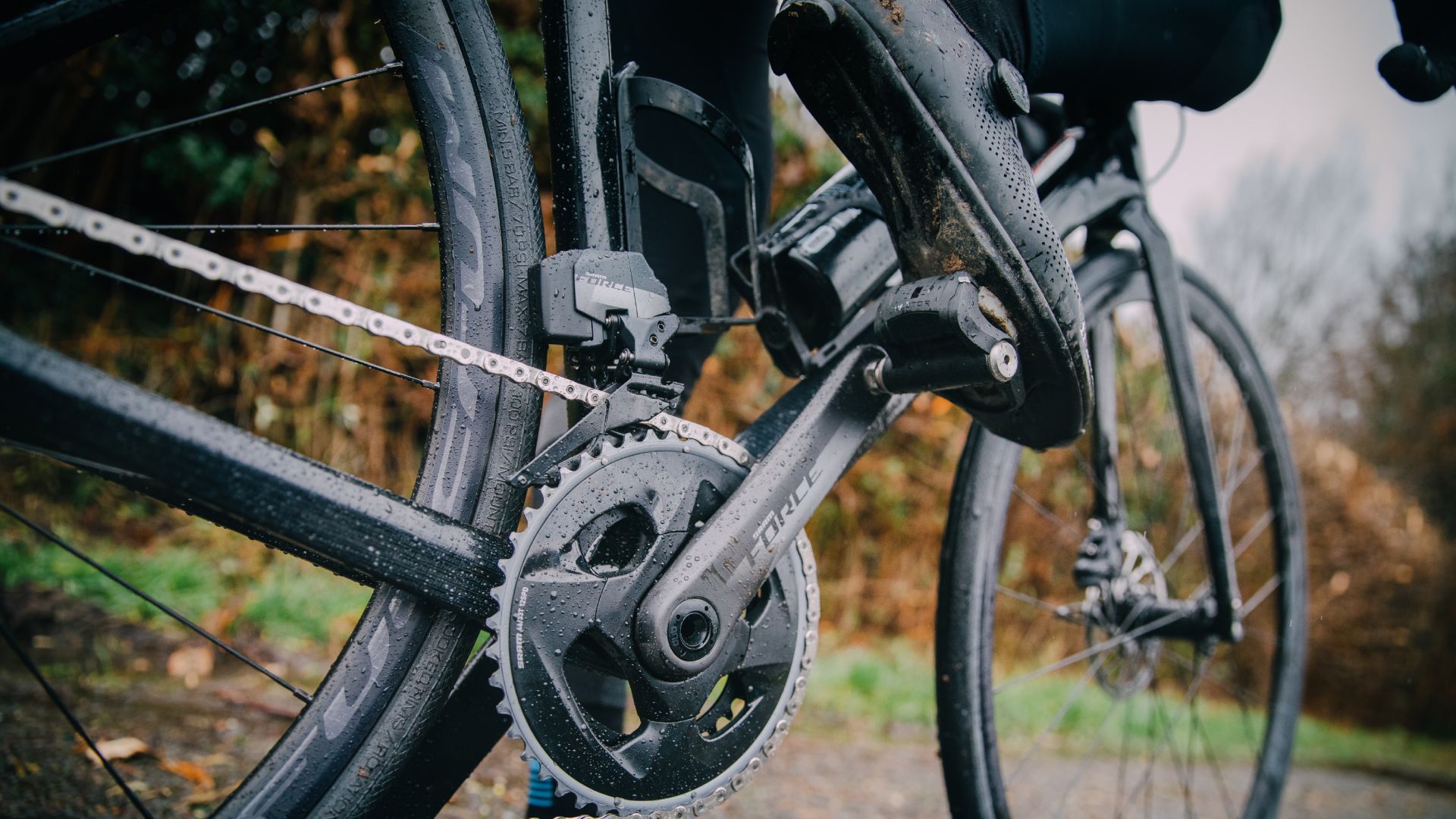
Using Quark's excellent power meter unit, the RED cranks are easy to install and provide consistent, reliable numbers. The cost is surprisingly reasonable, but it is best suited to an SRAM drivetrain due to its chainring configuration.

Favero's power meter pedals offer some interesting insight to you riding including platform offset
Our expert review:
2026 update - Aaron's thoughts after 7 years of use: I've been using the Favero Assioma Duo pedals since 2019 and, during that time, I've experienced zero issues - just confidence in the electronics. Even after seven years of rigorous use, the battery still delivers close to the claimed 50 hours. Due to their age, however, they often require firmware updates to keep them running gremlin-free. As far as accuracy and reliability go, they remain both.
These pedals provided reliable numbers for the entirety of my testing period, which was well over five months of solid use, through all weathers. Something that seems to bug power meters is that the Favero pedals never once failed to connect with my computer or the app. The magnetic charging connection is a minor detail I found myself really liking, meaning no fiddling with rubber seals and ports.
The extensive test period really gave me a chance to go through all the data. All are mostly useful for training, like left/right balance, and some are more novel but make for interesting reading, such as the amount of time you’ve spent pedalling out of the saddle.
The battery life is decent thanks to the rechargeable batteries, and the usage time is pretty much exactly what Favero claims at about 50 hours. While you can charge on the bike, I choose to remove the pedals to do this, to save my mucky bike in the house. I did wonder if you could charge them from a power bank, maybe?
The unfortunate pedal weighting prevents the pedals from getting a perfect 5/5 stars. The housing underneath the pedal, which holds all the measuring equipment and batteries, is heavy and causes the pedal to hang in an unconventional orientation. Which I found made clipping in and out a little more difficult than with other systems. This really only casued me issues on days where I was on photoshoot or filming, with lots of clipping in and out. For rides with lots of stops, like the local group ride, or stopping at junctions like riding through a city, this might be an issue.
A Look cleat system is used on these pedals which makes buying cleats pretty easy and cheap.

Garmin's Rally RK200 pedals are claimed to be accurate to +/- 1%
Our expert review:
Garmin's Rally pedals are a progression from the Vector 3. They've seen some notable improvements, firstly, a better battery door design that appears to eliminate issues with water ingress. Secondly, clever engineering means that you can swap the spindle between pedal bodies—using RS (Shimano), RK (Look), and XC (SPD-SL) style pedals and keeping the same power meter unit, although the pedal body conversion kits are expensive and, in my experience, not all that quick to do and quite fiddly.
The pedals look great and don't obviously resemble power pedals. Throughout my four months of testing, the Rally's performed extremely well, providing accurate readings with no frustrating dropouts or spikes. It consistently connected to the Garmin app, and I never once had it fail to detect my Garmin 1030 and 530, which is a welcome relief, as this can be very frustrating.
At first, I thought the Garmin readings were a little low in terms of power output, with a very disappointing result at the first time trial of the year. However, after a while, it did start to align with the Favero readings, which certainly means it was my form and not the pedals.
What really impressed me was the Garmin's accuracy during my ‘descending recovery sweetspot intervals’ session. It remained within 1 or 2 watts consistently throughout testing with a Quarq Dzero fitted to a SRAM etap bike I had on test. To be fair, this difference could easily be attributed to the near impossible task of pressing 'lap' on two computers simultaneously while on the rollers.

4iiii's Shimano 105 compatible power meter is a cinch to fit and lightweight too
Our expert review:
2026 Update - Andy's thoughts after four years of use: The 4iiii Precision 3.0 single-sided power meter remains resilient and reliable, even nearly 4 years down the line. A few battery changes are all that have been required over months of use and thousands of kilometres of riding. Having tested alongside some dual-sided options, however, it is interesting to see that personal imbalances do contribute to the single-sided power curve. For example, I know my left leg is more powerful at lower intensities, but things even out at higher intensities. This explains the differences I saw when I first tested, where it appeared to over-read at lower intensities and read lower relatively at higher outputs. It does, however, remain consistent, so it works well for tracking your own performance. If you want more data, you can also upgrade to a dual-sided 4iiii Precision 3+ Pro unit I tested in 2024 by getting it installed on your drive-side crank arm, also.
4iiii has delivered a reliable and inexpensive left-side crank that, at 9 grams, is one of the lightest power meters on the market. Compatible with Shimano cranksets, the Precision 3.0 uses the same power meter specification regardless of whether it’s fitted to a 105 crank (which I tested) or a Dura-Ace model.
The 4iiii Precision only measures left leg power, but you can easily adjust the scale factor on the 4iiii app to account for a known imbalance in your power output between your legs. While dual-sided is almost always more accurate, this is a good entry into using power, and with some support from a coach, it shouldn't cause too many issues. Given that you can continue to use your own pedals and crank, lowering the cost has many benefits.
My testing found that the 4iiii is sufficiently accurate and consistent to itself, meaning Precision 3.0 is a useful training tool for those wanting to track their progress using power. You will need to test this against, say, a turbo trainer to work out the difference and factor this in when tracking improvement and performance. I was cross-referencing my data with a Wahoo Kickr V5 which was giving me around a 10% difference. As I mentioned while this isn't ideal it did stay the same through out the duration of testing.
Installation and switching between bikes are effortless. Calibration with my Wahoo Computer, while reliable, was slow, which means you need to be prepared before heading out the door for a ride. This brings me to my final point: I noticed a slight difference in readings due to temperature changes between indoors and outside. 4iiii does recommend you acclimate the unit before zeroing and riding. So, while warming up or cooling down your power meter, you can connect your computer.

According to our tests Wahoo's Powrlink pedals are durable and super reliable
Our expert review:
Durable and highly reliable, the Wahoo Powrlink Zero dual-sided power meter pedals are a premium product for those who prefer the flexibility of the Speedplay cleat/pedal platform – and they’re also fairly priced compared to the competition.
Incredibly easy to set up and use, the build quality is outstanding, and there were no pairing issues either.
I was really impressed by their accuracy, too. However, my single caveat is that the pedals appear to ‘smooth’ slightly, meaning that peak sprinting power appears lower for the shortest duration. Once I spotted this, I could account for it and having said that, they were within 1 or 2 watts always of my Wattbike.
I did noticed that if you don't follow Wahoo's guidance on 'settling' the pedals before use, they underread quite significantly, despite Wahoo's claim of them automatically calibrating and zeroing. This can be done via the app and by going a few hard track stand starts, which is a bit of a faff if you constantly swap them between bikes.
Post-ride analysis on the Wahoo app includes left/right balance (with the dual-sided version), average and maximum power, TSS, normalized power, power curve, and time in zones—which covers most training needs. However, you don’t get pedalling dynamics data, such as torque effectiveness or pedal smoothness, which can be found on Garmin and Favero models.
It's hard to fault the Powrlink; after six months of use, I have had almost no issues. The build quality is top-notch, as is always the case with Wahoo products. Lastly, they are fairly priced.

Favero Assioma MX-2 pedals are excellent value compared to the Garmin XC200
Our expert review:
As with all our power meter testing, I put the Assioma Pro MX-2s up against two other devices to compare data accuracy. This consisted of a turbo trainer which like the 4iiii 3+ Pro, showed some slight indiscrepancies as the power increased but thankfully was consistent and repeatable. For many, this would just require you to understand the differences when swapping between outside and inside.
I also put it up against the SRAM Red Quarq power meter which showed an identical, and rather alarming, imbalance in my left-right power output. Otherwise, the data was absolutely spot on.
Really all that can separate the Assioma and the Garmin Rally pedals is the fact that the MX-2s are rechargeable and of course the cost. If you purchase the Assioma's direct from Favero they are nearly half the cost of the XC200s. That is hard to ignore and really makes the MX-2s the power meter pedals to have.

SRAM uses Quarq's DZero power meter to deliver its readings
Our expert review:
SRAM uses Quarq's DZero power meter to deliver its readings, a previous winner in our Editor's Choice awards. The Quarq power meter that forms part of the SRAM RED AXS groupset proved to be accurate, durable and reliable, without being anywhere near one of the most expensive on the market.
Our tester escaped dropouts and power spikes during testing and found the data reliable - reading about 4 watts above a Wahoo Kickr, which is a reasonable number accounted for by drivetrain losses.
The SRAM RED AXS power meter is a solid unit for those seeking easy, reliable, and accurate numbers from a power meter.
Type
Compatible with..
Best for...
Accuracy (claimed)
Reading Type
Battery
Pedal based
Any drivetrain, most computers and apps
Road/Zwift
±1%
Dual-sided
Rechargeable
Pedal based
Any drivetrain, most computers and apps
Road/Garmin Users
±1%
Dual-sided
LR44 Cell
Crank arm
Only available for Shimano Road & MTB
Road/Beginners
±1%
Single (Non-drive side)
CR2032 coin cell
Pedal based
Any drivetrain, most computers and apps
Road/Wahoo Users
±1%
Dual-sided
Rechargeable
Pedal based
Any drivetrain, most computers and apps
Gravel/MTB
±1%
Dual-sided
Rechargeable
Chainset
SRAM only, most computers and apps
SRAM drivetrains
±1%
Dual-sided
CR2032 coin cell
Cycling Weekly has a team of testers with vast experience testing bikes, components, clothing, and accessories across various price and spec levels. Our experience means you'll have a consistent, in-depth viewpoint reflected in our product scoring.
During power meter testing, to determine each device's accuracy, we rely on extensive knowledge of data analytics and data interpretation to assess how easy and precise the system is for everyone to use. This means that, occasionally, we consult with experts and specialists in the field to assist with our reviews—experts like Cycling Weekly regular contributor Andy Turner. Andy is a Sport and Exercise Scientist, a fully qualified and experienced Cycling Coach, and a Performance Consultant who knows how to analyse this data.
Like anything we test, we have a list of criteria we expect a product to meet. When testing power meters, these include overall accuracy, reliability, ease of use, durability, and weight.
Determining accuracy is not always easy, and we take steps to ensure we at least know how these products perform relative to the competition. This is why we simultaneously test all our power meters against at least two other devices we know to be reliable and accurate. This is almost always a turbo trainer and another pedal or crank-based system. Where possible, this can also mean multiple bike computers or watches.
What tests do we perform to determine this accuracy?
Each tester will perform slightly different tests; however, all will target a few key areas to understand a power meter's strengths and weaknesses.
Sustained averages are the primary test, similar to an FTP test, for setting the baseline. Responsiveness testing is also key to how quickly a power meter reacts to changes in effort; it is typically tested using short sprints, such as a 10 x 10-second effort. Just as importantly, our testers will use hard climbs and high cadence recovery to gauge dropout and reliability.
Learn more about How We Test.
Michelle began her career like so many aspiring journalists at her local newspaper before join the the cycling industry in 2012. She has been Editor Total Women's Cycling before joining the CW team. Prior to welcoming her first daughter in 2022, Michelle raced across road, track, and in many time trials. That hasn't totally stopped her though, in fact far from it. She continues to train, albeit mostly indoors, in readiness for the days when she is child free to put rubber to tarmac.
Andy is a Sport & Exercise Scientist with his own coaching and consultancy business. Which means a large part of Andy's day is spent analysing clients' data, such as power output, and helping them to increase it, along with many other performance metrics.
Let's start with, What is a power meter?
A power meter is a device fitted to a bike that measures the power output of the rider.
Strain gauges deflect slightly when a force is applied. By measuring this torque and combining it with angular velocity, power (measured in watts) can be calculated.
It's a good way to gauge your effort while riding that's less prone to being affected by extrinsic factors than heart rate measurement. Some riders swear by regularly testing their functional threshold power to measure how training is going. You can find out what is FTP in cycling and how to improve it on our dedicated page.
Watts are the energy required to a move a mass a certain distance in a known time period. So in bike speak, the mass is you plus your bike, and the distance is the ground covered.
Moving a bike, though, is a far more complicated scenario as its resistance to motion is far from consistent. In layman's terms, then, this equates to: power = force x velocity.
This is the key to understanding how a power meter works. It's essentially applying that equation to a given part of the bike - be that bottom bracket axle, crank, hub, pedal axle etc.
Accurate measurement of this force is one of the biggest challenges power meter manufacturers face, placing the utmost importance on the smallest of details such as the placement of the gauges, the quality of the gauges themselves and even the temperature of the measured material.
Currently, the best power meters can be placed in four key areas of a bike and how they work will depend on their location, although they will all use a type of strain gauge.
Of course, each has its advantages and disadvantages.
Pedal-based systems are easy to fit and change between bikes, but can be less accurate owing to the complexity of the force measurement. What's more, being exposed puts them at greater risk of damage.
Popular examples include the Garmin Rally and Favero Assioma, and Wahoo has recently launched the Powrlink Zero Speedplay-compatible power meter. Power meters of this type can also be single or double-sided.

Bottom bracket systems can be accurate and low maintenance. However, installation is more difficult and is made all the more complicated by the varying bottom bracket standards available today.
Factor in that a system of this type may not fit your bike and it is also possible that you have to run a different brand chainset to the rest of your groupset. Examples include Rotor INPower.
Chainset-based power meters can be very accurate but it is worth factoring in that they don't measure individual left/right power, although they can estimate it.
Similar to bottom bracket systems, they are not as easy to swap between bikes, unlike pedal-based systems, and there can be compatibility issues. Examples include the fabled SRM (the original power meter), Power2Max and Quarq.
Crank arm-based systems can be relatively easy to swap between bikes. Like pedals, they have the potential to be single or double-sided and popular examples include the Stages crank arm and 4iiii Precision meter.

You can buy single-sided power meters that measure power from one side, usually the left, and then double the reading to estimate your total power output from both legs.
A single-sided only measurement means doubling a single leg's power may not be a fully accurate representation of your power, but it can mean they are more affordable.
It may be worth checking if you have significant imbalances before opting for a single-sided meter. Note a 48/52% balance between legs is common.
Combined power meters effectively combine the power from both right and left legs and do not measure it independently. An example would be an SRM power meter.
Note that these systems, although accurate, will not differentiate which leg the power comes from.
Left/Right side power meters, or double-sided power meters are found on more modern and more expensive power meters that have gauges in multiple locations, such as pedals and some crank-based units.
This can be useful in establishing if you have an imbalance (one leg much more powerful than the other) and for working on pedaling technique. It can also be used if you are recovering from a single leg injury.
Dual-sided measurement is limited to power meters that measure power in more than one location, such as pedals, but also more expensive crank-based units, like Rotor 2InPower.

There are lots of schools of thought about how to train and race effectively. Some people swear by tracking data, others steer well clear, but as with most things in life, most think it's about striking the right balance. Our feature on using a power meter in training is a really great insight into what the experts say, acknowledging the best power meters as helpful tools, but not to lose touch with your rider instincts.
This largely comes down to the riding and racing you do, as well as which power meter system comes stock on your bike or one you've already bought. While there's no right or wrong option here, as a personal preference, pedal-based power meters let you quickly switch them between bikes, providing consistent readings throughout the season.
Newer off-road-specific power pedals from brands such as Favero Pro MX-2, Garmin Rally XC200, and SRM feature robust builds that can withstand rock strikes, dust, water, and the harsh realities of off-road racing and riding.
What you want to look for is a power pedal that houses all the electronics and strain gauges safely within the spindle, ensuring all the intricate parts are protected from the elements.

Everything rated here and the vast majority of power meters transmit via ANT+, allowing them to connect to most bike computer systems, including Garmin and Wahoo.
Most power meters also offer Bluetooth Smart connectivity - a handy tool for connecting to indoor training apps such a Zwift and Trainer Road, or smartphones, as well as for practicalities such as updating power meter software. Most cycling computers also now have Bluetooth connectivity built in.
Our guide to indoor training apps for cycling compares the best on the market and helps you identify which one you are most suited to. If you are wondering about power meters and turbo trainer compatibility, our page on best smart turbo trainers includes the latest models.
If the current climate means slim pickings on indoor trainers, or finances mean having to choose one or other, you can always bypass the smart trainer altogether and just use a power meter and simple turbo trainer. You'll need a couple of other sensors but can still work out as a much cheaper Zwift set up and you have the bonus of outside use once warmer weather arrives.
Yes, even if you are using bottom bracket based power meters, there will be the supporting software to enable you to measure cadence, as it's necessary for the power meter to derive your power output.
There is an incredible variety of power meters now on the market, which has helped their popularity, volume of sales and therefore helped bring the prices down. However, it's still very much a developing technology, which has to be accounted for in the end price.
From our experience, it's a 'you get what you pay for' product. The best power meters will have invested a significant amount of research and development in ensuring that the end product is consistently accurate, robust enough to withstand forces and harsh environmental conditions and to develop the supporting software.
Entry level - typically £250-£400/$300-$500
At this price you are likely to get a single-sided measurement that doubles the reading to estimate both legs. Stages 105 cranks are available at this price, as are 4iiii and the outgoing Garmin Vector 3 single sided power meter.
Mid-level - typically £550-£800/$700-$1,000
Mid-price starts to see pedal-based systems and dual-sided meters. Crank and chainring systems also become available. Professional athletes are increasingly using meters at this price point. Favero Assioma pedals are a fine example.
Top end - £900/$1,200 +
At the top of the market, we find dual-sided measurement and crank and spindle based systems. Examples include the Rotor 2InPower and SRM.

If you want to learn how to ride with a power meter, it's worth reading our guide on training with power. It contains plenty of useful information on maximising your gadget's potential and applying the metrics to your training.
The simple answer is yes! In fact, there are several benefits to using a power meter rather than one of the best smart trainers. First of all, consistent data from your indoor and outdoor riding makes it easier to track your training goals and means you don't need to do much maths.
Increased accuracy: Power Meters tend to be more accurate, with a variance of +/- 1%, compared with some of the best cheap smart trainers, for example, which can be up to +/- 3%. Also, smart trainers measure power 'downstream' at the cassette, which means power numbers will read slightly differently than 'upstream' or more direct readings from pedals or cranks.
It also means you can use a 'dumb' or wheel-on-trainer to save some cost, and even one of the best bike rollers, to do your training, which can increase your enjoyment and reduce the monotony of indoor training.