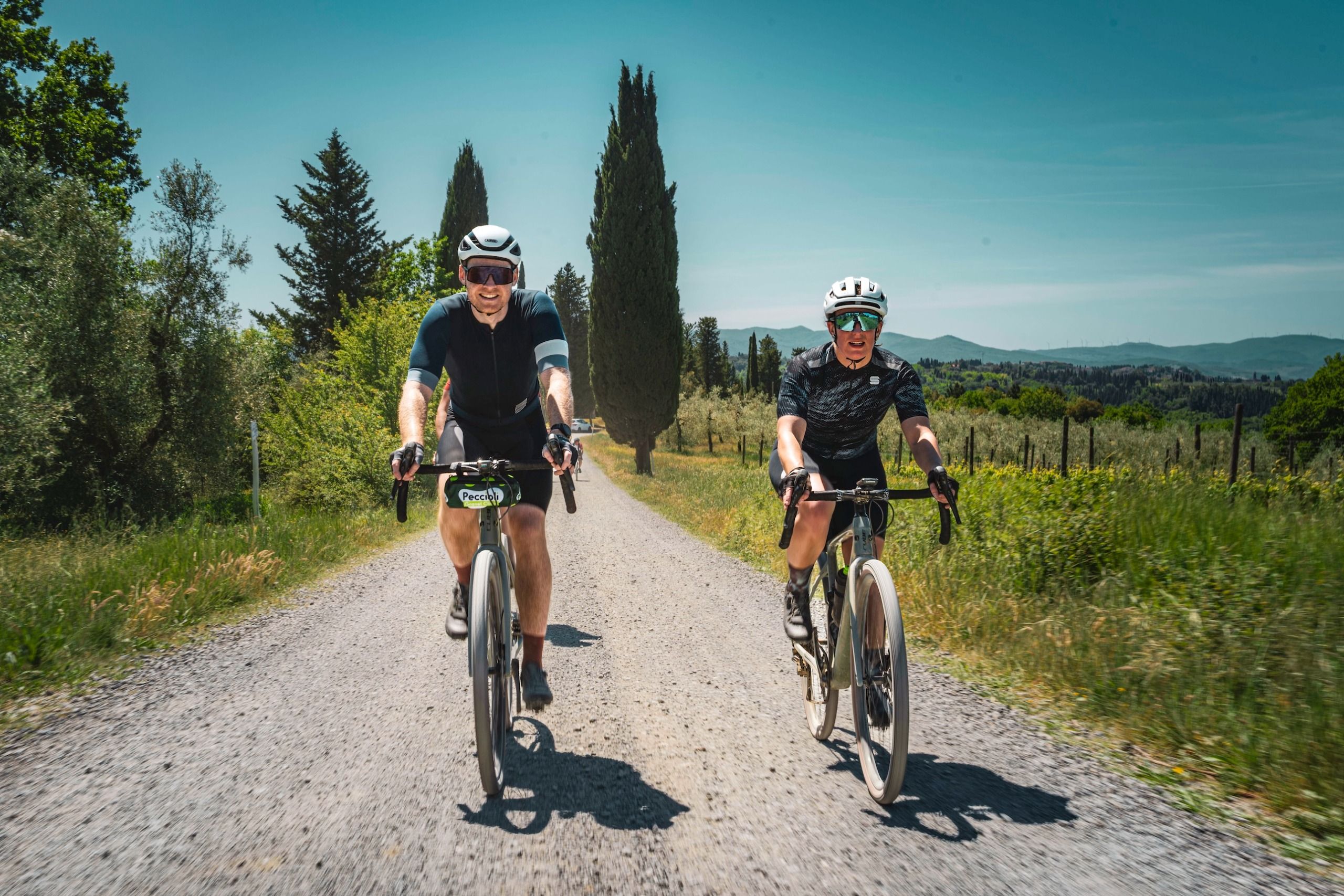
With three days to overhaul our gravel riding skills, CW heads to Tuscany to learn from the experts
“The idea is to start with a professional mentality, even though we are here to have fun,” says Marco Pavarini. He is the president of Italian cycling organisation ExtraGiro, and one of the organisers of Peccioli Gravel Clinic: a three-day, immersive gravel riding workshop in Valdera, Tuscany. It is the first of its kind in Italy, designed to help off-road newbies like me to ride more efficiently and improve our confidence. I am sitting in the introductory session, delivered in Italian, with Google Translate open on my phone.
There are about 30 of us in the room, with varying levels of experience. Pavarini invites us to share our aims: some want to optimise their set-up; others to improve their descending; a few to convert their road experience to gravel. Everyone wants to explore this lesser-visited part of Tuscany, which is basking in May sunshine. Eventually, it is my turn. I tell them that my aim is to enjoy it as much as possible and to see how much I can learn about riding on gravel.
Back in London, gravel riding is an answer to the biggest problem I have with road cycling: traffic. There are fewer early starts, less segment-chasing, more immersion in nature. Last year, I bought my first gravel bike from my dad’s friend Ray (a steal at £350). But frankly, my bike handling and technical skills could still use some improvement. So here I am.

The format of the clinic is simple: three days of guided riding – between 50 and 70km per day, always with over 1,000m of climbing – with technical sessions in the evenings, covering topics including bike set-up, biomechanics and nutrition. This preparation ramps up to a final “race pace” ride with two-time world champion and Olympic gold medallist Paolo Bettini. It is centred around Peccioli, a hilltop village that is at the heart of pioneering efforts to combat rural decline.
Organisers ExtraGiro have assembled a crack team of coaches, mechanics, guides and even a camera crew to join us on the rides. There is Luigino ‘Oscar’ Veneziano, former mechanic at Marco Pantani’s Mercatone Uno; biomechanic Fabrizio Pederzoli and, the star of the show, Francesco Casagrande, who recorded 51 career victories, but also served a nine-month doping ban in 1998. He held the Giro’s maglia rosa for 11 days in 2000, losing it during an uphill time trial. “That’s the [loss] that sticks with me the most bitterly, because between finishing second and winning a Giro d’Italia, there’s a world of difference,” he tells us. “You need mentality, determination and passion as a pro cyclist, because if you don’t enjoy it, you quit.”
On the first day, the team help us set up our Cube Nuroad Pro hire bikes. Pederzoli adjusts saddle heights while Veneziano inflates our tyres to a squishy 35psi with a whirr of his tiny electric pump. On a gravel bike, we learn, the saddle should be lower for more control, with a smaller drop to the handlebars – 4cm, says Casagrande, compared to 6–8cm on a typical road bike. Tyre pressure, meanwhile, should be lower for rougher roads; higher for “champagne gravel”. “You should always keep pressure slightly lower on gravel,” he says. “Better a bit less than a bit more.”
We ride the undulating 50km “Constellation Loop” through cypress-lined lanes, up relentless hills and along dusty strade bianche. The May sun is warm and the countryside is green and fragrant: it smells of cypress needles, rosemary, woody juniper. On the first climb, the group immediately starts to splinter. It is “not a competition”, we are told, but there is some initial showmanship: best kits, best bikes – and an attempt to conceal heavy breathing. Riding in a group this size pushes me to ride through ruts I’d usually dodge and to carry more speed through corners, doing my best to match the others’ pace on climbs (manageable) and descents (more problematic). There is no choice but to adapt.
Casagrande, meanwhile, looks comfortable, dancing up climbs on the drops or checking on members of the group. He converted to mountain biking after his road career, so he’s equally comfortable riding off-road. On one arm, he has a tattoo of the Olympic rings; on the other, a pulse line interrupted by a bike (Olympian Bettini, in case you’re wondering, has a tattoo of two clinking wine glasses). “Tutto bene?” Casagrande asks when he passes. There is a language barrier, of course, so I give him an enthusiastic thumbs up and say: “Si, bene.”
For Pavarini, Peccioli Gravel Clinic is also a slow-tourism project, designed to showcase the area’s landscapes, villages and culture. “I think that the bike economy is a way to support small towns, small territories,” he says. Over the four days, we visit Peccioli itself, with its medieval centre, viewing terrace and wealth of public art. We do a night ride to the Libbiano Astronomical Centre, where an enthusiastic astronomer shows us the master telescope, and we observe Jupiter with its two moons. Our rides take us through villages including colourful Ghizzano and quaint Legoli; to lunch spots like Agriturismo Diacceroni, where we are interrupted by a donkey. We visit the family-run Venerosi Pesciolini winery, and, on Sunday, join the local party, Festa sulle Serre. The routes, which intertwine and overlap, are pleasingly designed to build familiarity with the area, like a jigsaw puzzle slowly being completed.

Rising from the rubbish: the Giants of Peccioli, part of the 'Presenze' installation by Naturaliter at the Triangolo Verde waste plant
On the gravel, I pick up tips: descend on the drops, pushing my weight backwards; climb seated, and resist the temptation to spin in too low a gear. In one technical session, Pederzoli draws a clock-shaped diagram on the board. “Memorise this: I generate 80% of my pedal drive between the one and five [o’clock positions].” This drive, he says, should come from the glutes, while the circle should be closed with a pulling movement like wiping a shoe on a doormat.
Bettini shares some of his own advice too: “Speed always pays off. Speed gives you stability,” he says. “On terrain that isn’t stable, where the bike moves around – it may seem strange, but the slower you go, the easier it is to crash.” He is right, of course. Too little speed – too much caution – increases the chance of wheels being sent off their line. Steep gradients are best approached with full commitment: push hard on climbs and lay off the brakes on descents.
As I grind up the hills, I think of Pederzoli’s pedalling advice, visualising the push from my glutes. Pleasantly, I find that I am less fatigued. At one point, he even tells me that my pedalling style is perfect (“forte! Perfetta!”). My problem, though, is on the steepest descents, where I can’t bring myself to go onto the drops. I resolve to continue to practise in private.
On the third morning, I ask Pederzoli if he can adjust my bike position and cleats to stop the dull ache that has developed in my long-ailing left knee. He moves my cleat backwards slightly, twisting it by a millimetre or two. This, he says, improves comfort and stability, while the cleat should be in line with the widest metatarsal part of the foot (he recommends marking this with a piece of duct tape). Pederzoli determines that my saddle should also come forward – a move I am sceptical about. It turns out, though, he is right.

Champion and mechanic: Paolo Bettini (left) and Luigino ‘Oscar’ Veneziano, who once tended Marco Pantani’s bikes
In the afternoon, it is time for the “race pace” ride with Bettini, something I’d gravely underestimated. Bettini was taking no prisoners. I lose contact before the end of the first climb: too slow, too many leftover beans from lunch in my saddlebag. After a few grumbling kilometres as a ‘chasse patate’ – caught between the lead group and the stragglers – I drop back and give myself time to appreciate some of the most technical gravel sections of the trip. One stretch is like the bottom of a riverbed: full of loose, chunky rocks and deep gullies on which previously I’d have got off and walked. I take Bettini’s advice and push hard. The rocks move, the wheels skid, my arms vibrate – but I’m across, I’m upright, and I’m enjoying it.
In future editions, Pavarini intends to enhance the “clinic” aspect of the event, with more practical tips and advice for bikepacking. I have certainly gained confidence over the three days, partly because of the coaching, and partly due to the level of support, which creates a safe environment in which to experiment. Above all, the clinic provides access to gravel’s most important teacher: the strade surface itself. I gain a better sense of how it moves, which lines to choose. I get used to how it purrs under the wheels, the plumes of dust, and how the rocks skitter as you slow down. The experience is so immersive that when I go to bed at night, I replay sections – a corner, a rocky descent – and I can almost feel the sensations.
“For each of you, the question must be: why do I ride a bike?” asks Bettini in the final session. I have often wondered this myself, commuting in the rain, slogging up hills, having an altercation with a driver. But here, feeling the Tuscan sun on my skin, smelling the countryside, listening to the birds, the answer is clear. For this.

Getting there
Pisa, around 30km from Peccioli, is the nearest airport. Flights from London start from around £35 return. Florence, which is well-served by flights to the UK, is just over an hour away.
Where to stay
We stayed at Le Palaie (lepalaie.it), a 150-hectare country estate where old farmhouses have been converted into self-contained accommodation, surrounded by vineyards and olive groves. Le Palaie’s winery is also on site, where guests can visit the cellar – and, crucially, try the wine. Prices start at around £100 per night.
Sign up to the clinic
The Peccioli Gravel Clinic fee (TBC for next year) includes accommodation, breakfast, lunch, guided rides and training. Italian language recommended. Pre-registration is open for next year’s event: peccioligravel.it. Bikes can be hired from gippobike.com.
Beyond the bike
Don’t miss Peccioli’s highly successful waste management plant, Triangolo Verde, an unusual attraction that generates electricity for the town. The profits it generates – €345m (£299m) so far – have funded the MACCA open-air museum, a treasure trail of over 70 contemporary public art installations – and helped Peccioli secure the title of “Italy’s most beautiful village” in 2024. The Terrazza del Palazzo Senza Tempo is a viewing platform by Italian starchitect Mario Cucinella, while Endless Sunset is a bridge which changes colour throughout the day – and provides lift access to the town’s upper levels. It’s also worth visiting villages Ghizzano, Legoli and Lajatico, the birthplace of tenor Andrea Bocelli, who is proudly celebrated on every wall.
This article was first published in the 11 June 2026 print edition of Cycling Weekly magazine – available to buy on the newsstand every Thursday (UK only) while digital versions are available on Apple News and Readly. Subscriptions through Magazine's Direct.