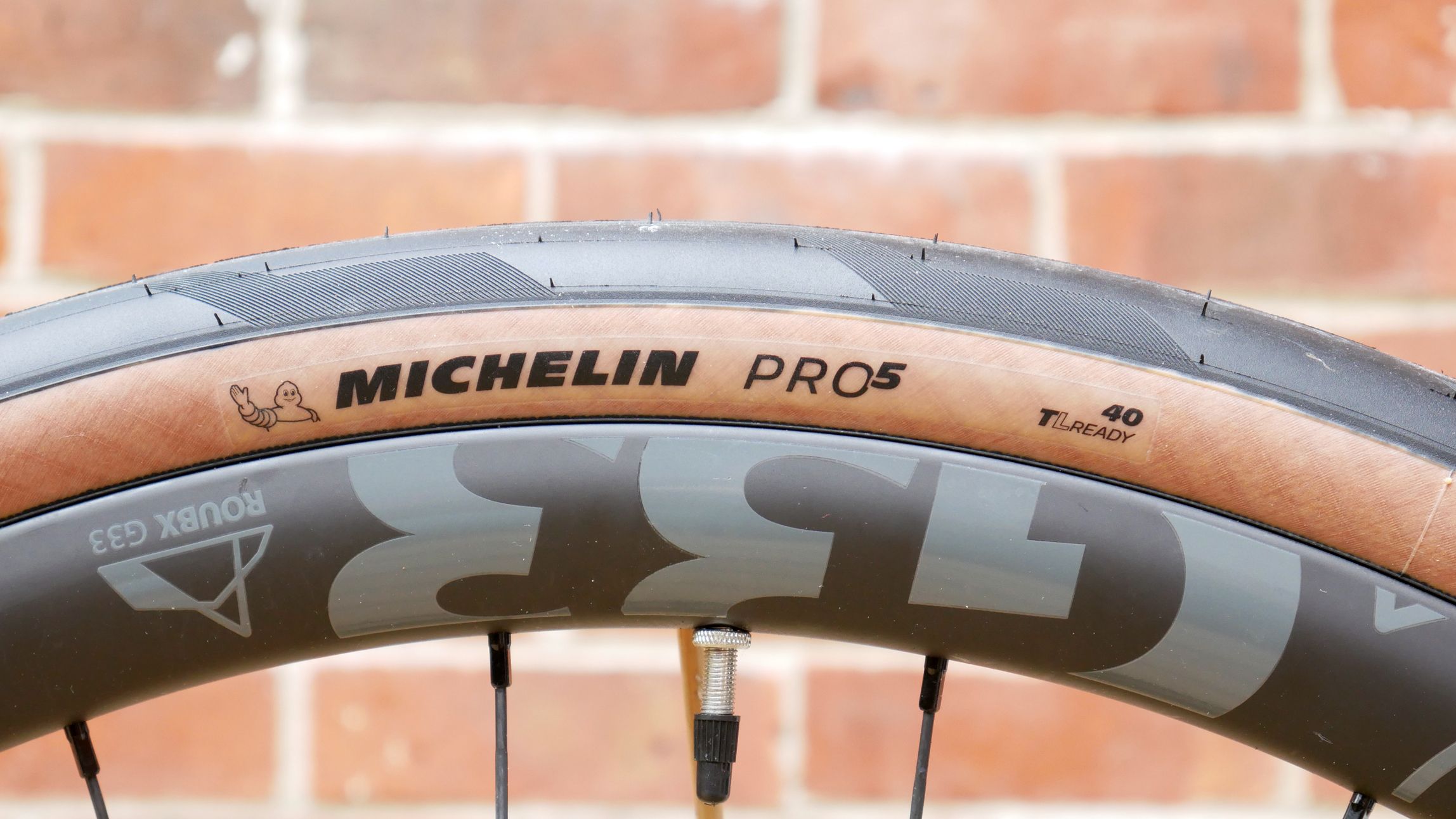
Options for slick 40mm endurance and all-road tyres have been slow to materialise, but Michelin has just set the benchmark really rather high
Despite the wealth of best endurance and all-road bikes now offering up to 40mm tyre clearance, and numerous gravel bikes that can easily swallow a tyre of this size, tyre manufacturers have been slow to support this with more road-oriented offerings.
Before the Michelin Pro 5 TLR 40mm, there were really only the Pirelli P-Zero Race TLR 40 I reviewed last year and a more recent entry from Vittoria, the Corsa Pro 42mm (which is likely too big for many endurance road bikes anyway).
Honestly, Michelin was not really on my radar. I had envisioned that the next brand to enter the ring would be a little more established in the best gravel tyre market, and one that already offers ‘wide-road’ tyres. So, let's get into why I think the Pro 5 is now the benchmark.
The Michelin Pro 5 TLR is the result of the brand completely overhauling its competition tyre line. Michelin claims it is 35% more efficient thanks to a new GUM-X rubber compound, and says the added performance comes at no cost to durability or compliance.
A new bead-to-bead shield layer lets riders run lower pressures, again reducing rolling resistance while increasing compliance and durability. You'll find this change across the entire Pro 5 offering, from 28mm right up to the 40mm tyres I have on test, which weigh 462g/16.29oz.

Once again, a tyre that caused me no issues with fitting or inflation; in fact, these were even easier than the Hutchinson Caracal Race I tested earlier in the year. I don’t know what it was about the Pirelli P-Zero Race 40mm, but the Italian brand has decided to be very tight on tolerance, and while I would normally applaud this, they have taken it to the extreme.
Once inflated with one of the best floor pumps, the Pro 5s measure exactly 40mm wide on my 25mm internal-rim wheels.

Before checking any data, the Pro 5 felt immediately faster than the P-Zero tyres and not noticeably slower than the Caracal Race, which happened to be the tyre I was coming off. A quick check on bicyclerollingresistance.com backed up this feeling: the P-Zero at 17 watts, the Pro 5 at just 14, and the Caracal at 13 (just for reference). This just makes the Michelin feel more like a road tyre and less like a ‘slick gravel’ tyre.

This feeling was helped by the Pro 5’s overall shape; Michelin has opted for a much rounder, balloon-like shape. This is a style of tyre I prefer even on a mountain bike. While subjective, it's a shape I feel more comfortable with and, as a result, I can push the grip limits more, as there's a more predictable lean transition.
I’m almost certain this shape also makes the Pro 5 more compliant, allowing the sidewalls to 'bulge' and 'give way' more easily. I noted that at 40psi on the P-Zero, it was fairly uncomfortable. However, 40psi on the Pro 5s was a fit-and-forget number, and one I almost didn’t stray from, other than to do my due diligence for the sake of this review. That suppleness started to dip into the high 40s and low 50s, which I think is reasonable.

Dropping pressure towards 30psi was a little more troublesome; that rounder shape introduced some on-road wallowing and unwanted deformation; the further increase in compliance really made me want to push the tyres' limits off-road, though. Here I settled on a happy medium of 35 psi.
I think anyone who believes these types of tyres are just for the road is mistaken. At 40mm, their volume and at low pressures are, of course, going to make you curious, and I couldn’t resist – especially as the South Downs looked more like Strada Bianche for much of this summer than the slippery and slimy chalk I’m used to.
Off-road, the Pro 5 continues the theme of being predictable and comfortable, largely unfazed by most detours off the blacktop, even when the terrain gets a bit chunky. Yet despite these off-road excursions, they proved just as durable as the Pirelli over the 500+ km covered.
The Pro 5 TLR represents stonkingly good value. At just £54.99 per tyre in the UK and around $80 in the US, it's considerably cheaper than Pirelli P-Zero Race 40mm and Vittoria Corsa Pro 42mm. Broadly speaking, Michelin is at the cheaper end of the tyre market right now – where the likes of Schwalbe and Continental are nudging into the £100/$120 per tyre. It's great for riders, as it proves performance doesn’t have to cost a lot, and it should be a wake-up call for those charging more.
I found the Pro 5 truly offers fantastic all-round performance that right now is unmatched, with brands either heading too far down the durability or performance route.
The most surprising part about riding the Pro 5 is that it weighs the same as the Pirelli (262g versus 264g), yet they couldn’t be more different tyres. I can wholeheartedly recommend the Michelin Pro 5 TLR (in tan wall, of course- let's not get crazy) for anyone with a modern endurance bike, or looking to fit one of the best gravel bikes with a set of road tyres.