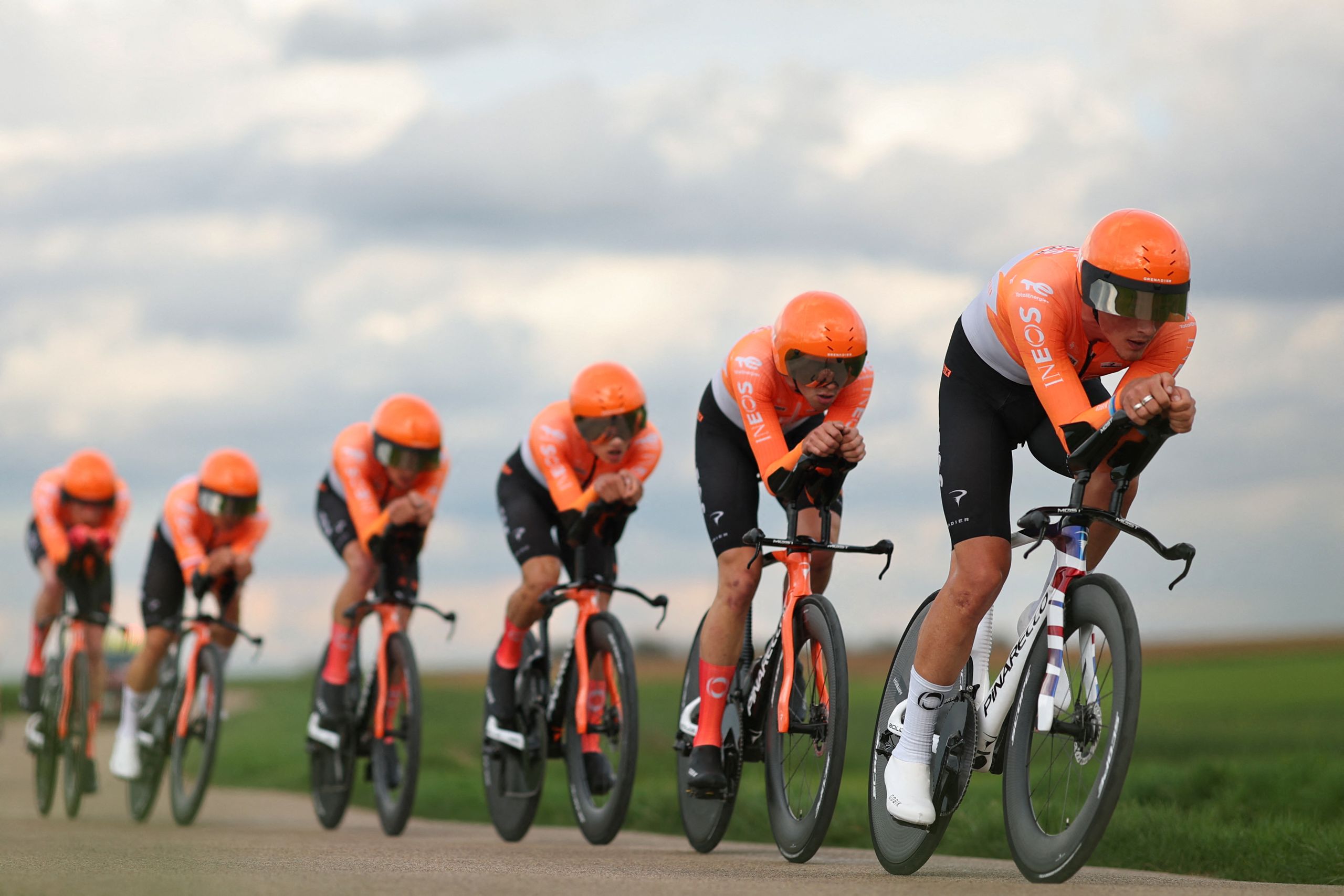
How does the team time trial at the Tour de France work? The individually timed format has a dress rehearsal at the Tour Auvergne-Rhône-Alpes
Expect to see lead-out efforts, rather than teams finishing in neat lines
For the first time since 2019, a team time trial is back on the menu at the Tour de France this July, but now there’s a twist: times will be recorded individually, not as a team.
Anyone who has watched – or indeed competed in – any of the last four editions of Paris-Nice will already be familiar with this every-man-for-himself timing rule. ASO has been trialling it at the race since 2023, and will do so again on Tuesday afternoon on stage three of the Tour Auvergne-Rhône-Alpes, in what has been billed as a key dress rehearsal before the Tour de France’s opening stage in Barcelona.
So how does an individually timed team time trial work? Do the riders still race together? And is it the winning team or individual who is declared the stage winner?
Team time trials exist to test speed, unity and cohesiveness against the clock. Riders typically race in a close line, sheltering from the wind and saving the strongest riders for crucial moments.
Historically, and according to standard UCI rules, a team’s time is taken on the fourth rider across the line, with all riders granted that same time in the stage and general classifications. In recent years, however, event organisers ASO have tried to make the format more exciting at their races by introducing individual timing.
The rules in place on Tuesday’s stage three of the Tour Auvergne-Rhône-Alpes dictate that each rider will receive their own individual time in the team time trial. As previous editions of Paris-Nice have shown, teams tend to treat this as a lead-out effort; many protect their leader for as long as possible, before releasing him to attack the final part of the stage.
The winner of the stage is the entire team, rather than the fastest individual. At Paris-Nice this March, for example, Kévin Vauquelin clocked the fastest time, and so his Netcompany-Ineos team were declared the stage winners.
In the general classification, it is the riders’ individual times that count. As such, riders aiming for high overall placings will try to finish as quickly as possible, while those unconcerned by the GC may drop off the back of their team’s paceline, and roll across the finish line minutes later.

Teams splinter as the stage hunters and GC hopefuls come to the fore.
There is still a time limit, however, and any riders finishing outside a generous extra 30% of the winner’s time will be eliminated from the race. At Paris-Nice, Vauquelin’s time was 26:40, meaning the time limit was 34:40, or an extra eight minutes. No rider missed the time cut.
Announcing the new format ahead of the 2023 edition Paris-Nice, ASO said: “This should force each team to adopt the best strategy to lead out their leader in the final stretch, which is not unlike team spring events on the track. The innovation should also stop a whole team sweeping the top GC standings.”
Six-time British time trial champion Alex Dowsett described the individual timing as “brilliant” at the time.
“The most efficient way of doing the race will be to have your GC guy dropped off with 500m to go," Dowsett explained. "Maybe he has taken some turns, maybe he hasn't, that depends how strong he would be, and how much energy they want to save for days to come.”
Tuesday’s team time trial at the Tour Auvergne-Rhône-Alpes is 28.4km long and takes place on a loop from the commune of Perreux. The stage begins at 15:05 CET (14:05 BST) and the starts are organised in ascending order according to the team classification, with the exception of the race leader’s team starting last.
The team time trial at the Tour de France will be shorter, at 19.6km, and will open the race on the first day in Barcelona. The race’s first yellow jersey will go to the individual rider with the fastest time on the stage.