Tour de France jerseys: Yellow, green, white and polka dot explained
We explain what the yellow, green, polka dot and white jerseys worn by riders in the Tour de France represent
Jersey colour
Classification
Yellow
General classification, overall leader
Green
Points
Polka dots
Mountains
White
Best young rider
The Tour de France sees the world's best cyclists compete over three and half weeks for the honour or wearing the yellow, green, white and polka dot jerseys, awarded on the basis of general, points, mountains and young rider classifications.
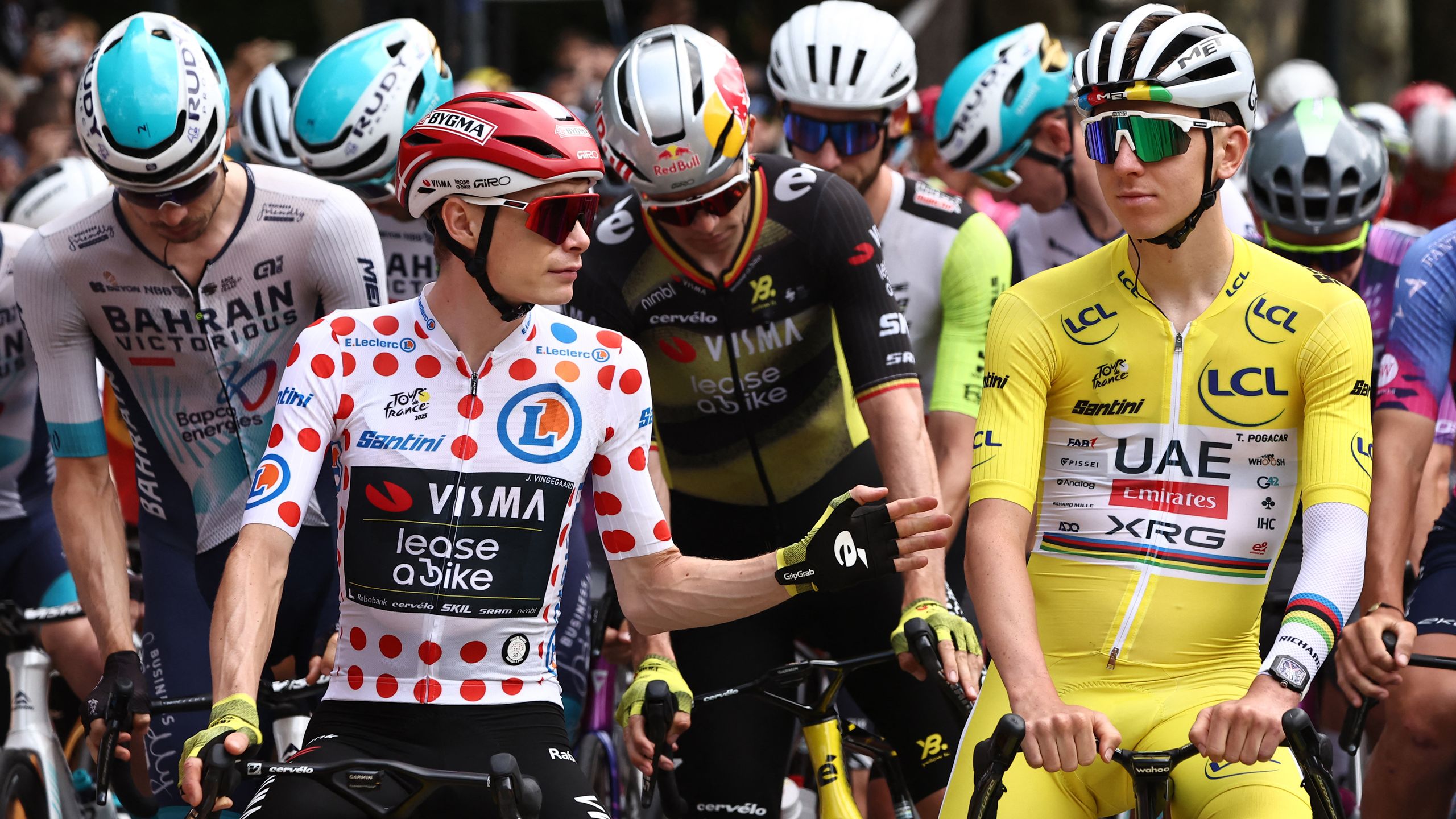
The jersey for each category is presented to the leader of that classification at the end of every stage, and the recipient earns the right to wear it during the following day's racing. If a rider takes the lead in multiple classifications, they wear the most highly prized jersey (with the yellow jersey being prioritised, followed by the green, the polka dot and the white), and the next person on the ranking wears the kit in the leader's stead.
Here we take a brief look at what each jersey represents are and how they are won.

Tadej Pogacar riding through Montmatre in the yellow jersey on the last day of the 2025 Tour de France
Also known as the maillot jaune, the Tour de France yellow jersey is the most coveted piece of kit in professional cycling. The rider who earns to the right to wear is the one who has completed the race (up to that point) in the least amount of time - in other words, the person who tops the overall or general classification (GC).
Tadej Pogačar (UAE Team Emirates) dominated the GC in 2020 and 2021, wearing the yellow jersey almost throughout the 2021 edition, before Jonas Vingegaard (Jumbo-Visma) took it off him halfway through the 2022 race, wearing it until the end of the race. The Dane won again in 2023, but in 2024, Pogačar roared back, dominating the race and wearing the yellow jersey from stage 4 right until the end of the race.
Last year Pogačar sealed his fourth Tour de France win with another impressively imperious performance, first wearing yellow after winning stage 4, briefly relinquishing it to Mathieu van der Poel and Ben Healy before seizing it back and keeping hold of it for the final 10 stages of the tour.
Before that, in 2012, Bradley Wiggins became the first British rider to finish in Paris in the Yellow Jersey - with Chris Froome following up in 2013, 2015-2017. Geraint Thomas took the 2018 race, becoming the third British rider to win the race.
The yellow jersey is sponsored by LCL, a French bank, and it is yellow, because the Tour's original organiser, L'Auto, was a newspaper printed on yellow paper.
A time bonus of 10, six and four seconds will be awarded to the first three riders across the finish line each day (not including TTs). These bonus seconds are taken off their stage and therefore overall time.
Last 10 winners of the Tour de France general classification:

Italian rider Jonathan Milan from Lidl - Trek took the green jersey in 2025
The green jersey relates to points awarded to riders according to the position they finish on each stage, with additional points for intermediate sprints during some stages also on offer.
The number of points on offer varies depending upon the type of stage. More are awarded during pure flat, sprint days, while on hilly and mountain stages there are fewer points up for grabs. The points are added up after each stage and combined with points won in all previous stages. The green jersey (maillot vert) is awarded to the rider with the most points. Sometimes it is a sprinter's game, sometimes more of an all-rounder – like Wout van Aert (Visma-Lease a Bike).
The jersey took its colour because the initial sponsor was a lawn mower manufacturer – though the colour was changed once in 1968 to accommodate a sponsor. It is now sponsored by Škoda, and has a newer shade.
Both Eddy Merckx and Bernard Hinault successfully won both the general classification and the points classification with Merckx achieving the biggest sweep in 1969 with the points, mountain and general classifications to his name. Over the last ten years, Peter Sagan has triumphed in the points classification on no less than seven occasions.
After Sagan's period of domination, the green jersey has had a different winner for the last five seasons.
The following points are on offer:
Flat stages (stages 5, 7, 8, 11, 12): 70-50-40-35-30-26-24-22-20 points (descending in increments of two to 15th place)
'Slightly' hilly stages (4, 13, 17, 21): 50-30-20-18-16-14-12-10-8-7-6-5-4-3-2 (descending to 15th place)
Hilly stages (stages 2, 4, 9, 13): 30, 25, 22 points (descending to 15th place)
Mountain stages and ITTs (6, 10, 14, 15, 16, 19, 20): 20, 17, 15, (descending to 15th place)
Intermediate sprints: 25-20-16-14-12-10 (descending in increments of two to 15th place)
Last 10 winners of the Tour de France points classification:

Mountains points are awarded to riders who reach the summit of classified climbs first. Points vary depending on the category of each ascent, with more difficult climbs awarding more mountains points.
Climbs are divided into five categories: 1 (most difficult) to 4 (least difficult) - then there's the 'Hors Categorie', denoted by HC which represents the most challenging ascents of all. The tougher the category, the more points are on offer, and they're distributed to more riders - so while a HC climb will see points awarded down to the first eight over the summit, a fourth category climb results in points for just the first rider over the top.
The organisers decide which mountains or climbs will be included in the competition, and which category they fall into. If the stage features a summit finish, the points for the climb are doubled.
The points are tallied up after each stage and added to points won in all previous stages. The distinctive white-with-red-dots jersey (maillot à pois rouges) is given to the rider with the most mountains points. The first climber's award was given out in 1933, and the jersey arrived on the scene in 1975. It is now sponsored by Leclerc, a supermarket.
Sometimes the competition is won by the overall winner, as has happened with Pogačar and Vingegaard in recent years, while sometimes it has been taken by specialists.
Points awarded as follows:
HC: 20-15-12-10-8-6-4-2 pts (in descending order to the first eight riders to summit)
1st cat: 10-8-6-4-2-1 (to the first six riders to summit)
2nd cat: 5-3-2-1 (to the first four riders to summit)
3rd cat: 2-1 (to the first two riders to summit)
4th cat: 1 point (to the first rider to summit)
The souvenir Henri Desgrange and a cash prize is awarded to the first rider over the race’s highest point, the 2,642-metre Col du Galibier on stage 20 of the 2026 race, but this year that doesn't come with any additional bonus points.
Last 10 winners of the Tour de France mountains classification:

Florian Lipowitz won the white jersey in 2025
The plain white, young rider classification jersey is awarded to the fastest rider born after 1 January 2001, making them 25 or under. It is sponsored by Krys, an opticians.
First introduced in 1975, riders such as Marco Pantani, Alberto Contador, Egan Bernal and Tadej Pogačar have all won the young rider classification, helping propel them onto bigger and better things during their careers.
Pogačar was dominant in the white jersey competition, but he is no longer eligible. Florian Lipowitz (Red Bull-Bora-hansgrohe), but there is a certain young man from Decathlon who might his eye on this prize this year.
Last 10 winners of the Tour de France young rider classification:
There are two further classifications that do not earn the winner(s) a coloured jersey - the most aggressive rider award and team classification.
While not necessarily a classification, the Combativity Award is given to the rider who has shown the most fighting spirit during each individual stage, as chosen by the race jury. They will wear a gold race number during the following day's stage. A 'Super Combativity' award is handed out on the final stage for the most aggressive rider during the whole race - in 2025 it went to Ireland's Ben Healy.
The Team Classification is based on the collective time of the three highest-placed riders from each squad. Leaders of the team classification get to wear race numbers that are yellow with black digits, and the right to wear yellow helmets (the latter is not compulsory). Last year this went to Visma–Lease a Bike.