Best cycling gilet 2026: Six vests expert-tested for versatility and protection year round
One of the most flexible pieces of clothing in your cycling wardrobe, and every cyclist should have one in their back pocket for cold starts or breezy days
Gilets (or for our friends across the pond, vests) are not as important as cycling shorts. However, when it comes to bang for your buck and versatility, the best cycling gilets are up there among the most valuable cycling garments you can have at your disposal.
On any given ride, the weather can change quickly, and even on a warm day you can easily get chilled on a long descent after a sweaty climb, and this is where a lightweight best cycling vest is worth its scant weight in gold. They are easy to pack in a jersey pocket and pair well with the arm warmers, providing significant weather protection without taking up much room.
In addition to lightweight, packable gilets, there are heavier-duty vests that provide even more insulation. These often don't pack down; instead, they are designed to provide extra warmth when paired with the best winter jacket or the best packable rain jacket, without adding restrictive bulk around the shoulders and arms.
Whichever you choose, you should ensure that the gilet is a good, close fit without being restrictive in the riding position, so as not to cause unnecessary drag or the dreaded flapping noise at speed. That is exactly why Tim loved the Castelli Espresso Vest, which offers a superb, unrestricted fit.

A tight fit doesn't have to be restrictive if done well like the Espresso Vest
Our expert review:
Reviewed by Tim Russon - Tech Contributor
Castelli's Espresso Vest uses a very stretchy, tightly woven fabric to provide its wind resistance and superb fit. Coupled with a mesh rear, it is very breathable yet adds more insulation than a simple Pertex-style Gilet.
On test, I loved the fantastic, close-to-the-body fit that didn't flap at all yet was entirely unrestrictive on the bike. It still packs down small and weighs very little so that it fits easily into a jersey pocket when not needed.
There are three rear pockets included, but no storage bag or pouch. I would have preferred larger reflective details, but otherwise it performed superbly.
The Espresso Gilet is available in a plethora of colours for men and women.
Read Tim's full Castelli Espresso Vest Review

Simple, but effective in all-weathers
Our expert review:
Reviewed by Andy Turner - Tech Contributor
The Rapha Pro Team Shadow Gilet shares much of its construction with the Shadow LS Jersey. Rapha has tried to address the waterproofing, low weight, and breathability of now-outlawed PFAS fabrics with a single-layer Micro-pore membrane, topped with a DWR coating for extra protection.
This jersey-like construction means Rapha has maintained a close, comfortable fit. What I like most is that it addresses one of the main gripes I had with the Shadow long-sleeve: heat buildup and moisture pooling at the cuffs. Removing the sleeves means this is no longer a concern. This makes the gilet far more versatile. Paired with a lightweight long-sleeve jersey, it was manageable up to 14˚C.
As for the waterproofing, it performs impressively well for a post-PFAS-era garment. In heavy rain, it gets saturated, but this is the case with most items nowadays. In light rain and road spray, it’s exceptionally good.
Read Andy's full Rapha Pro Team Shadow Gilet review

Our expert review:
Reviewed by Andy Turner - Tech Contributor
Similar to the Rapha Pro Team Shadow above, the Atmos Vest from Maap is a sleeveless version of the brand's Atmos waterproof jacket, designed to be incredibly lightweight, packable, yet protective.
The Atmos deploys a Pertex Shield three-layered fabric construction, boasting a 20k mm waterproof rating on the water column thanks to taped seams. What's astonishing about this design, though, is just how small this thing packs up.
It's the Atmos's actual waterproof performance that sets this vest apart. In winter showers and heavier rain, water beads off the vest with ease, preventing ingress and windchill. Because it is PFAS-free, long-term care is needed to maintain its waterproofing capacity. The key thing, however, is that the waterproofing performance straight from the off is as good as any other.
My only small gripe is that the body fit is quite short. More often than not, the jersey being worn underneath would protrude from the hem of the Atmos vest. It also means that without mudguards, there is very limited protection at the rear from wheel spray.
Read Andy's full Maap Atmos Vest review

Our expert review:
Reviewed by Tim Russon - Tech Writer
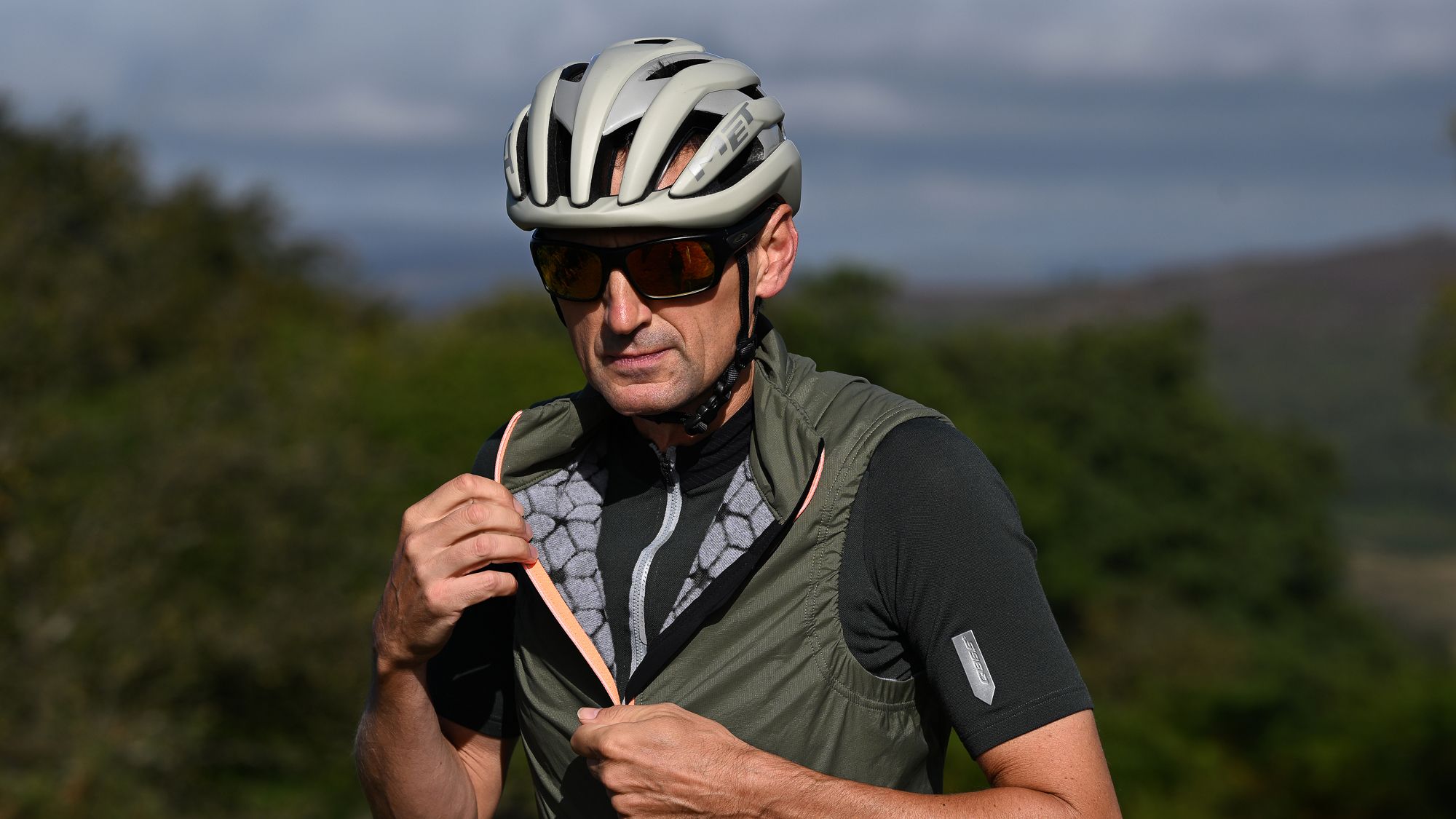
Whilst gilets are a staple cycling product that provide lightweight protection from chilly breezes and passing showers, the Adventure vest offers a bit more: it's a fully insulated gilet.
Made from a blend of synthetic material and merino wool, the UF Air Insulation is bonded to a fine-mesh drop-liner in rhomboid shapes to retain maximum warm air with minimal bulk. Despite this, the vest weighs only 115g/4.4oz and is still very packable.
The Adventure Vest has quickly become one of my very favourite garments. The warmth it generates with such minimal insulation is incredible and far more than a basic gilet provides. The cut, whilst not racy, is still close enough that I have worn it on both my gravel and road rides, proving very useful on cool starts and late finishes.]
I love the Adventure Vest, and so it found its way into my pocket or saddlebag more often than not. It’s ideal for keeping you warm in a variety of situations and weather conditions, particularly on my frequent trips into the mountains. I found the fit and cut very versatile, with phenomenal levels of warmth for its size and weight, and I foresee that my usage of it will only increase with the onset of autumn weather.
Read Tim's full Q36.5 Adventure Vest review

Side zips and front pockets might look odd, but work very well
Our expert review:
Reviewed by Hannah Bussey - Tech Writer
Santini's Alpha Pack Vest offers something a little different to the gilet norm. Aimed slightly more at gravel and casual riders than racers, it pairs a woven, wind-resistant shell with a warm Polartec Alpha lining, both of which work together to move moisture away from the body for greater comfort.
I loved its comfort and versatility, with warmth when required and great breathability. I would suggest it might be a bit warm for fast-paced rides, except in the very coldest months, when it will add plenty of extra insulation to your outfit.
There are three large rear mesh pockets and a wide front pouch to store plenty of snacks, tools, or extra layers, and the off-centre front zip avoids the zip rubbing against your chin.
Read Hannah's full Santini Alpha Pack Vest Review
In addition to our general testing guidelines, we assessed the gilets for a few key characteristics that make them more effective and useful.
A good, close fit without being restrictive helps keep out cold breezes and stops the gilet from flapping annoyingly at speed. The fabric should be highly wind-resistant and very breathable, and usually have a DWR treatment to ward off light rain or spray. As a garment that will hopefully spend a lot of time in your pocket (except the insulated gilets), packability was also high on the list of important attributes.
Thus, all the gilets were worn and carried for many miles on the road and worn in the rather variable British and North American weather in order to give our ratings.
Hannah is Cycling Weekly’s longest-serving tech writer, having started with the magazine back in 2011. She has covered all things technical for both print and digital across multiple seasons, representing CW at the spring Classics, Grand Tours, and all races in between.
Hannah lives just outside the Peak District National Park near Manchester, UK, with her partner, daughter and a small but beautifully formed bike collection. Her local is notorious for its weather, particularly rain, but as the name suggests, with every 'Peak' ridden over, a new weather system can come. Having a good gilet in her back pocket is something Hannah never leaves the house without.
Tim Russon is a writer and photographer who has worked in the outdoor and cycling industry for over 20 years. He prefers long, hot climbs in the big mountains, but as he lives on the edge of the Peak District like Hannah, he has to make do with short, cold climbs most of the time instead.
Tim's frequent trips to Europe, particularly the volcanic mountains of the Canaries and the more popular Pyrenees and Alps, mean he needs a versatile wardrobe that can do a lot with a little.
Andy is a Sport & Exercise Scientist, fully qualified and experienced Cycling Coach, Sports Director, Freelance Writer, and Performance Consultant. He spent 3 years riding for a UCI cycling team and 7 years as a BC Elite rider, competing in prestigious events such as the Tour of Britain and the Volta a Portugal.
Andy manages his coaching business, ATP Performance, alongside his writing and product reviews as an excuse to ride and keep fit, but more so to support his riders with up-to-date knowledge and equipment recommendations.
Wind Protection
When buying any gilet, protection against the wind should be top of your agenda. The insulation should take care of this on thermal gilets, but for lighter weight offerings, things are not always so simple, with only a thin layer of material, most commonly some form of nylon or polyester, to keep the chill off your chest.
However it’s not just the material that’s important, it’s what you do with it. A high neck with a close fit will prevent cold air from rushing down your front, while it’s also key that the holes for your arms are not overly generous to prevent air from getting in at the sides. This will also avoid windflap.
Good quality gilets might also offer some sort of design feature to prevent cold air from getting through the zip. This usually comes in the form of either a taped zip or a storm flap, essentially a strip of material which covers the back of the zip.

Choosing a gilet with a high collar will help to keep out the elements
Rain Protection
While the best waterproof cycling jackets will protect you from wet weather, it's handy to have a bit of extra protection in a vest. As pieces of clothing designed to be worn in spring and fall, plenty of the best cycling vests will also give you some sort of protection against the unexpected April shower.
While some vests are completely waterproof, this is obviously of limited use seeing as even if your torso is dry, your arms are still going to get soaked. Instead you’re more likely to find water-resistant gilets, designed to protect you from light showers and road spray, without sacrificing breathability.

A breathable mesh panel on the rear of the vest will allow hot air to escape
Breathability
Although not as much of a problem as with some waterproof jackets, the boil-in-the-bag effect is not something we want to see from a vest at any price-point. This can be a particular issue with vests which attempt to offer higher levels of protection, with windproof and waterproof fabrics doing a good job of keeping the elements out, but also, unfortunately, keeping body moisture in.
To this end, many manufacturers include mesh panels in their vests, occasionally constructing the entire rear panel from a more breathable material in order to let hot air escape without compromising windproofing.

A good lightweight cycling vest should pack down small enough to be stashed away in your jersey pocket
Packability
Obviously, this doesn’t apply to thermal vests, but seeing as you’re hopefully only going to be wearing your lightweight vest for the first hour of a ride, while the temperature starts to rise, or for the duration of an Alpine descent, it’s important that you choose one that can be easily stowed away for the rest of your ride.
It’s really a case of the smaller the better when it comes to packability, and ideally, you should be looking for a vest that packs down small enough not to take up an entire jersey pocket. Unfortunately, choosing a more feature-packed vest offering things like pockets and water resistance often comes at the cost of packability.
If you do find that you want to stow away a larger vest, then it's worth also investing in one of the best bike saddlebags for packing the essentials and freeing up some pocket space from tools or spares.
Finally, some vests come with their own stuff sack, which although useful when packing your gilet in luggage, often doesn’t keep it as small as if you really stuffed it down into the bottom of a jersey pocket.
Pockets/Access

A simple opening in the rear of a gilet will offer access to jersey pockets
Of course, you can just flip up the rear of your vest to access what’s in your jersey pockets, but this risks knocking items out of your pockets in the process. To mitigate against this, some vests offer a hole or two in the rear so you can get at your energy bars and gels.
Alternatively, a double-ended front zip that can be undone from the bottom also allows easy access to your pockets on the go without having to unzip completely.
Many vests also offer pockets for a little extra storage, although these are less useful on lightweight gilets as you don’t want to be emptying out your pockets at the side of the road when it’s time to shed the outer layer.
Bonus features

Be on the lookout for reflective details if you want added safety after dark
As with any piece of cycling kit, it’s possible to add countless extra features to the humble gilet. Plenty of brands offer either high-viz gilets or gilets with reflective elements for added safety after dark.
If you’re after a little extra protection, some gilets also offer a bum flap to keep your backside warm and dry, while others come with a drawstring or elasticated hem to stop cold air from entering from below.
If you are specifically thinking about road riding safety features, it's worth reading our page that reassures you that it is safe to cycle on roads but here’s how you can be safer.
As with any piece of cycling kit, this depends a lot on what sort of riding you’re doing. Lightweight vests are particularly useful for chilly mornings, so if you’re the sort to start your weekend ride while the dew is still on the ground, they can be a very worthwhile investment.
Also if you’re lucky enough to be planning either a training camp or summer getaway to the mountains, then a lightweight vest will be worth its weight (or perhaps more) in gold. Even at the height of summer, you’re going to feel the chill on descents that will often last more than half an hour, so sticking one in your back pocket is a must.
On average, we’d say that you should be looking at something around 70 to 80 bucks or quid for a good-quality lightweight windproof vest, although extra features such as rain protection might add a little more to the price tag.
However as with most things, the brand name is almost as important as the product itself when determining the cost, so expect to pay more if you’re looking to buy from some of the more fashionable names in the cycling market.
Of course, cheaper options are available, and there is quite a selection that comes in for much less, but be careful to look for one with a decent fit, as less expensive gilets can be liable to flapping in the wind. In addition, a lack of breathability in some cheaper vests can make things pretty sweaty.