Best bike locks 2026: every style extensively tested and rated for security and usability
Our cycling experts put all the best bike locks through rigorous testing, ensuring you can leave your bike anywhere, secure in the knowledge that it's safe.
The best bike locks are both a strong deterrent to thieves and a vital cycling accessory, whether you intend to commute by bike or secure your pride and joy at home.
Here at Cycling Weekly, we have tested hundreds of bike locks over the years, including a dozen I personally tested in the last year. These range from high-security angle-grinder-resistant bike locks and chain locks for securing bikes at home and at train stations to portable, lightweight bike locks for bikepacking and peace of mind during café stops.
I rigorously assessed the usability, functionality, and features of every lock I tested, only resorting to power tools for those that claimed angle-grinder resistance. In the UK and North America, Sold Secure handles the rest, while ART does so in Europe. These organisations independently test bicycle locks and categorise them using a straightforward performance-based rating system. Our reviews include their security ratings.
However, a reliable bike lock isn't the only way to secure your bike. Consider adding one of the best GPS bike trackers to significantly increase your chances of recovering it, and always make sure your bike is covered with the best bicycle insurance.
As I mentioned, there are various styles of bike locks, but our best overall choice is the OnGuard RockSolid for its resistance to angle grinders, low weight, and exceptional value. Because there is such a wide range of options, there are tips for selecting the right one for you in our How To Choose section at the bottom of this page.

Despite being only 1.3kg/2.8lbs, it is one of the most secure locks available right now
Our expert review:
Reviewed by Matt Ischt-Barnard - Tech & Ecomm Writer
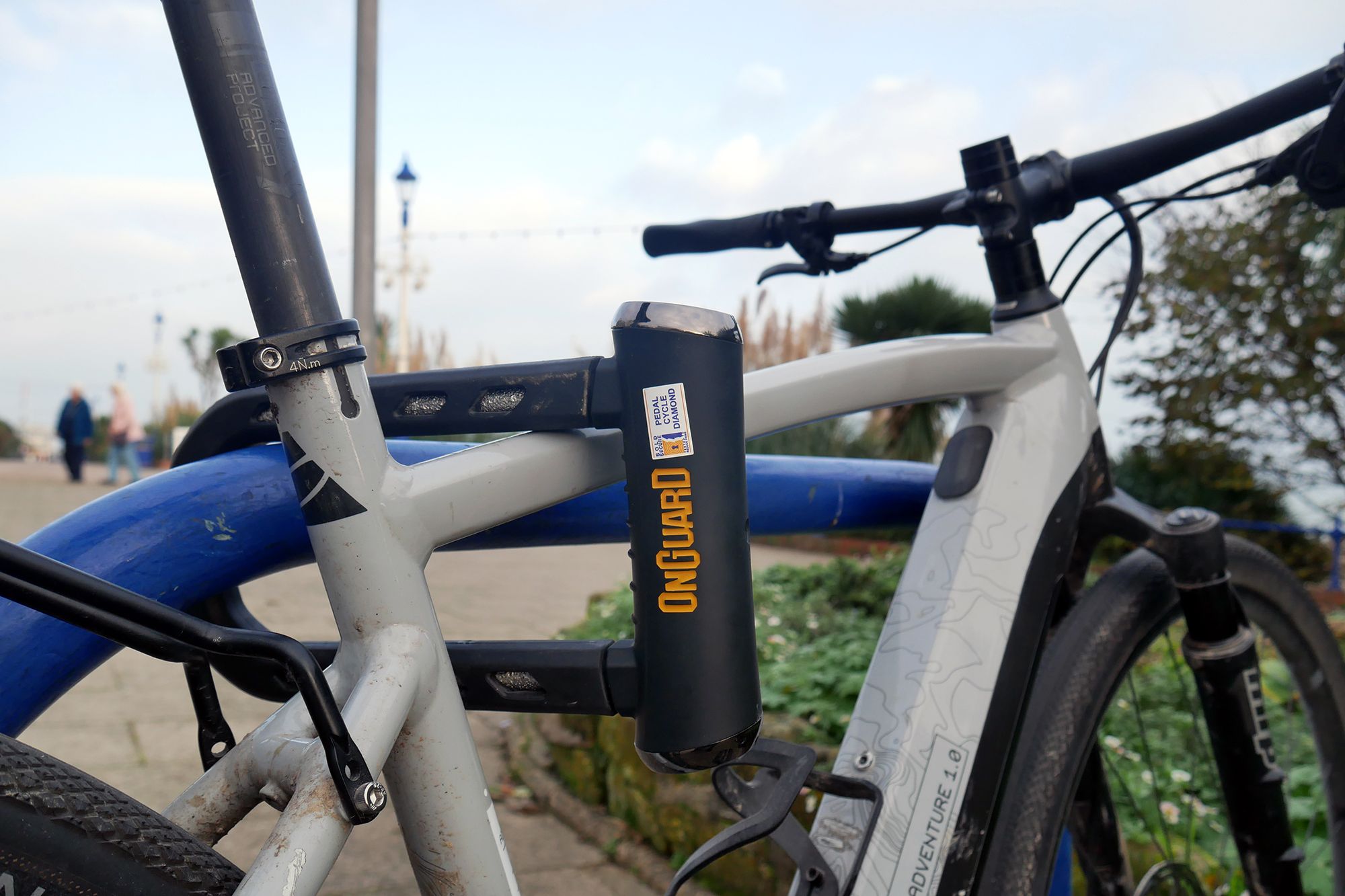
The OnGuard RockSolid 8590 is our top recommendation and best overall bike lock. It is light, portable, and incredibly robust. As the offspring of security giant Magnum Locks, OnGuard has applied a wealth of expertise and manufacturing know-how to create this small yet mighty Sold Secure Diamond-rated bike lock.
Made of hardened steel and coated with OnGuard’s patented RockSolid finish, the 8590 lock weighs nearly a 1kg/ 2.2 lbs less than its nearest competitor at 1.3kg/2.8 lbs. However, there is a compromise. It has the shortest shackle reach at 17.5cm/6.8 inches, which, with its 9cm/3.5 inches internal width, results in 157cm²/ 61.8in² of locking space volume.
Promising anti-pick, pull, and drill, the key-operated lock mechanism even has a weather shield cover, which should help prevent water ingress and any corresponding loch mechanism degradation or freezing in sub-zero weather conditions.
The OnGuard stands out in the field because of its capability to fend off grinder assaults. On test, we went through no fewer than three grinder discs in five minutes, the most of any lock we've tested. Even then, the grinder barely scratched the surface. This impenetrability is probably why the OnGuard RockSolid 8590 also comes with the most spare keys (five in total) because, trust me, this is not a lock you’ll release easily without a key.
Read Matt's Full OnGuard RockSoild bike lock review

The Litelok X1 offers a diamond security rating and superb angle grinder resistance
Our expert review:
Reviewed by Tom Epton - Tech Contributor
The Litelok X1 has inadvertently become among the cheapest available as a growing number of angle grinder-proof locks enter the market. The lock is diamond-rated, meaning you'll be covered under most insurance schemes. It requires multiple angle grinder discs to penetrate and weighs a reasonable 1.7kg, making it easy to carry around.
As I mentioned, there is a new wave of even more secure angle grinder-proof locks, such as Litelok's X3 and the OnGuard RockSoild. That shouldnt take away from the X1's overall performance, it is still a very secure diamond rated lock that offers pretty formidable angle grinder restistants. Our reviewer really enjoyed using the Litelok X1, especially because of its handy locking circumference. It made locking up the bike in all the various spots they needed a breeze!
For complete peace of mind—when your priority is your bike over the insurance provider’s obligations—the X1 still stands out as a superb choice.
Read Tom's full Litelok X1 bike lock review

The X3 offers a great balance of security, weight, reach and cost
Our expert review:
Reviewed by Matt Ischt-Barnard - Tech & Ecomm Writer
The LiteLok X3 is ideal for anyone seeking the same great Sold Secure Diamond-rated security as the OnGuard RockSolid 8590, but with a slightly longer shackle.
The British-designed and manufactured lock uses an exclusive material called Barronium. This super-hard ceramic composite makes the shackle virtually indestructible. During our five-minute angle grinder test, we only managed to cut halfway through the lock, an endeavour that ate through two metal-graded grinder discs.
The LiteLok measures 19.5cm/7.6 inches tall by 10 cm/4 inches wide, the equivalent of 195 cm²/ 76.7in² of total local volume, around 20 per cent more space than the OnGuard.
This extra size adds a little to the LiteLok’s weight when directly compared to the OnGuard, but at just 2.2kg/4.8lbs, it's the equivalent of an extra water bottle, so it's hardly excessive.
I really liked the LiteLok X3’s silicone outer layer, which helped prevent my frame from getting scratched. The nifty neoprene pouch was also a great storage addition for the lock. However, I wasn’t so keen to find that the bespoke bike frame lock mount would be an additional £20 outlay, especially after discovering that it wouldn’t fit most small frames, which is another point to consider when deciding to purchase.
Read Matt's full Litelok X3 Bike Lock review

Kryptonite's chain design offers plenty of flexibility when it comes to locking up your bike
Our expert review:
Reviewed by Luke Friend - Tech Contributor
Visually, the Kryptonite New York Fahgettaboudit chain lock is a serious deterrent to any thief. At 150cm long, made from a series of 14mm six-sided, 3t hardened manganese steel links and weighing just under 7kgs, it's a real brute of a lock. The proved padlock features a 15mm steel shackle, constructed around a disc-style cylinder which should offer effective protection against drilling.
Unsurprisingly, its heft makes the chain far too heavy to carry around, as someone who doesn't use panniers; after trying both around my waist and chest, the Fahgettaboudit was destined for home use only. Its Diamond rating and length were supreme for locking multiple bikes in the shed, reaching around both with enough room to lock it to an anchor.
Read Luke's full Kryptonite New York Fahgettaboudit Chain 1415

The Bordo 6500 Granit X-Plus lock offers a large lockable area that can secure two bikes if needed
Our expert review:
Reviewed by Stefan Abram - Previous Tech Editor
Folding locks offer several benefits over the venerable U-lock design. They tend to pack down smaller and have a larger lockable area, and their flexible nature greatly increases the range of objects you can lock your bike to.
The typical downside of a folding lock is that it has so many moving parts. They tend to be less secure than a simpler design, such as a U-lock. The hinge areas add a potential point of attack that's not there with U-lock.
As such, the Abus is one of the only Gold-rated folding locks currently available. However, this superlative security comes with a couple of trade-offs. At just under two kilos, the Abus lock is over four times as expensive and weighs just over half as much again as the Gold-rated Zéfal K-Traz U17.
The Bordo Granit X Plus certainly isn’t all things to everyone—but it isn’t trying to be. As a high-security folding lock, it performs excellently. In addition to all the general benefits of folding locks, the Abus has a comprehensive rubber coating to protect your paintwork, a bike mount that is simple to set up and to use day-to-day, as well as an integrated weather seal on the lock barrel—adding some very welcome weather protection.
On review, we found the bike mount not only straightforward to use but also capable of keeping the lock firmly in place, even when we were cycling on uneven and bumpy roads. Once we'd arrived at our destination, the Bordo Granit X Plus' large lockable area made it easy to lock up our bike without any fuss; in fact, we even locked up two town bikes using the one lock.
Read Stefan's full Abus Bordo Granit X Plus 6500 bike lock review

Our expert review:
Reviewed by Luke Friend - Tech Contributor
Gram-for-gram, the Pitbull mini packs quite a punch. Despite only weighing 1.3kg it delivers a Diamond Sold Secure rating. It achieves this by measuring just 9cm x 14cm while still featuring a 14mm hardened steel shackle and a pick, pull and drill-resistant ‘bump lock’ cylinder. Its weight and dimensions makes it easily portable, either using the supplied mounting bracket or stuffed into a bag;
I found it rattled less than a larger U-lock when mounted to the frame although it didn’t feel quite as solid as either of the folding locks. Naturally it’s size means the internal locking space is small, and will limit how and what you can lock your bike too - so perhaps not ideal for those who require some flexibility.
However if you're locking your bike up to the same point each time, and know this compact lock fits, then it’s a great way of reducing your carrying weight without having to sacrifice the security rating.

The Z Lok is our best lightweight and portable lock and is well-suited to coffee stops
Our expert review:
Reviewed by Paul Norman - Tech Contributor
The Z Lok weighs only 70g, so you won’t feel burdened if you stuff it into your pocket or clip it around your frame. Its design resembles an oversized zip tie, and inside the plastic covering is a steel ribbon.
We reckon that if you use the Z Lok to secure your frame to a post or railing, it’s enough to stop a thief from walking away with your bike, although it’s unlikely to stand up long to a bolt cutter and its security level is unrated. Its steel band design is significantly more robust than other lightweight locking options, which tend to use thin cables, though.
At 40cm long, our reviewer found that it’s long enough to secure your frame to something immovable and possibly your rear wheel. Because of its zip tie-like design, you can also shorten the loop to make it harder to get leverage with a cutter. When unlocked, there’s a release lever to undo the ratchet.
In summary, we found that it’s a clever, useful piece of kit to carry around for coffee stops or quick bike errands. It's also cheaper than a full-strength lock.
Read Paul's full Hiplok Z Lok Combo bike lock review

Seatylock Foldylock compact is a fantastic compact folding lock that really takes the fight to Lock giants Abus
Our expert review:
Reviewed by Luke Friend - Tech Contributor
As the name states, it’s a small folding lock. It comprises six steel bars, joined by stainless rivets, that add up to a circumference of 85cm; I found this internal locking space offers just enough room to secure the lock through the front wheel and frame before attaching it to a bike rack or similar. Due to its smaller size, it was less cumbersome and thus easier to use than the folding Abus - it’s as quick to lock up as U-lock but with a little added flexibility that’s inherent in the design.
When folded away it measures just 18.9 x 6cm, which likely makes it one of the smallest and lightest Silver-rated locks around. Again, like the larger Abus lock, it can be secured to your bike’s bottle cage mounts using a plastic case; similarly, it feels secure and silent when in transit. If a combination of weight and portability is important to you then the Compact should have plenty of appeal.
Read Luke's full Seatylock Foldylock Compact lock review

Our expert review:
Reviewed by Luke Friend - Tech Contributor
The Granit Xplus 540’s 23cm shackle height and 10.8cm inner width means you have plenty of room to manoeuvre. While it doesn’t offer quite as much flexibility as the brand’s Bordo folding lock, it still allows for a variety of locking possibilities.
Its Diamond rating is secured through a combination of 13mm temper hardened steel square parabolic shackle and a double bolting shackle and lock body, with the latter designed to deliver protection against picking. The lock also has the feel of something that’s well-made and features an automatic keyhole cover; having had a couple of locks jam on me in the past, this is a worthwhile detail.
It comes with a flexible mounting point that allows it to be attached to the top, down and seat tube - depending on your frame of course. It’s certainly light enough to carry in this manner, although like all ‘full-size’ U-locks it’s likely better stored in a backpack. Its security rating also makes it another consideration for home use.
Security Rating
Weight
Type
OnGuard RockSoild 8590
Sold Secure Diamond
1.3kg/2.8lbs
U-lock
Litelok X1
Sold Secure Diamond
1.7kg/3.7lbs
U-lock
Onguard 8006 Pitbull Mini
Sold Secure Diamond
1.3kg/2.8lbs
U-lock
Abus Bordo Granit X Plus 6500
Sold Secure Gold
2.4kg/2.5lbs
Folding Lock
Litelok X3
Sold Secure Diamond
2.2kg/4.8lbs
U-lock
Abus Granit XPlus 540
Sold Secure Diamond
1.6kg/3.5lbs
U-lock
Kryptonite New York Fahgettaboudit Chain 1415
Sold Secure Diamond
6.9kg/15.2lbs
Chain Lock
Seatylock Foldylock Compact
Sold Secure Silver
1kg/2.2lbs
Folding Lock
Hiplok Z Lok Combo bike lock
Not Classified
70g/2.4oz
Strap Lock
The Cycling Weekly testing team tested locks against the varied rigours of urban and utility cycling, using them on rides to the Bath & London offices, the supermarket, pubs, and to run errands around town.
Our testing is primarily focused on the everyday use of a specific lock. Ultimately, our rating will depend on key metrics such as weight, shape, locking mechanism, mounting attachment, tactile feel, security rating, and value – essentially every lock quality in real-world scenarios.
The Cycling Weekly tech team seldom subjects a lock to destruction testing unless it asserts that it is angle grinder resistant, and there's a valid reason behind this. There are reputable, independent, and officially recognized testing organizations like Sold Secure. Moreover, as I have pointed out throughout this guide, no bike lock can be considered completely unbreakable.
A great way to safeguard your bike is to get an insurance policy that specifies the required security rating for your bike lock.
For more details on how Cycling Weekly tests products, check out our How We Test page

I began commuting by bike for work well before entering the bicycle industry. From age 13, I delivered newspapers, and I continued on to my first real job at 16, where I relied on biking due to not having a driving license. I often choose my e-bike instead of the car, even taking my son along. In 20 years, I haven't had a bike stolen, which suggests I'm very fortunate or mastered bike security. In the last 12 months, I have tested over a dozen bike locks.
Luke Friend has worked as a writer, editor and copywriter for over twenty five years. Across books, magazines and websites, he's covered a broad range of topics for a range of clients including Major League Baseball, Golf Digest, the National Trust and the NHS. He has an MA in Professional Writing from Falmouth University and is a qualified bicycle mechanic. He has been a cycling enthusiast from an early age, partly due to watching the Tour de France on TV. He's a keen follower of bike racing to this day as well as a regular road and gravel rider.
The first point to clarify is that no bike lock is 100% foolproof. The best way to safeguard your bike is through an insurance policy, so if your bike is unfortunate enough to be stolen, you'll at least have it replaced swiftly. Insurers will specify the level of security your bike lock must meet for them to provide compensation.
The level of security you need will depend on the requirements set by individual insurers. Some insurers will always require a lock that meets at least the Gold Sold Secure standard. Others may be content with silver-rated locks for bikes valued under £1,000/$1,000, but you’ll need to verify the wording of your policy first.
The general guideline is to purchase the best lock you can afford. Ideally, one rated Gold or higher. Aim to invest at least 10% of your bike's value in security, which may include a GPS tracker or several locks.
Selecting the right bike lock means balancing the best compromises with your needs. Four main things to consider are where you will leave your bike, for how long, its value, and how you will transport the lock.
Where you leave your bike is important for several reasons. The location can depend on how many eyes and witnesses there are to a theft, determining the security level required. This also extends to the features by which you can secure your bike, such as a bike rack compared to a lamp post or railing, and this specifies the flexibility you need in a bike lock.
For how long is, how long might a thief get to break through your lock? If it could be for extended periods, especially if the bike is out of sight, you will certainly need to select higher security levels.
Your bike's value is likely important not just to you and the cost of replacing it if it is stolen but potentially to an insurer, too. A rough guide in the past has been to spend 10% of the value of your bike on a lock, and if your bike is over £1000/$1250, it should be Sold Secure gold or above. This guidance is potentially a little dated, with the cost of bikes having risen significantly in recent years. However, it's a good starting point, and with diamond-rated locks now available from around £50/$65, there should be a high-security option for most bikes.
Transportation of your bike lock can be one of the most difficult points to overcome. If you always travel with a backpack or pannier, purchasing the highest security lock you can carry is fairly simple. Travelling light or using your commute as training time can be a little more difficult, and where folding or wearable locks become really appealing. Some even supply a mount for your bike; check before making a purchase, as this is not always the case.
There are many different styles of bike locks, each designed with a particular use case in mind:
U/D locks - identified by their shape. Whether you look at them locked or unlocked, the terms are interchangeable. U-locks offer the highest security levels and a good balance between practicality, weight, and security. Available in various sizes, U-locks can also be purchased with alarms or even offer angle-grinder resistance.
Chain Locks - Characterised by their chunky appearance and all too often heavy weights, chain locks, akin to U-locks, offer high levels of security. Unfortunately, their greater flexibility does little to offset the impracticality of transporting them. This makes them ideal for use at home, securing multiple bikes or covering long distances to anchor points.
Folding Locks - By far the most flexible and practical to carry, with many mounting to a bottle cage, you can always have your lock on hand. The very nature of the folding mechanism offers a weakness that can be exploited, which does reduce effectiveness. Folding locks could suit backpackers, shoppers and couriers.

Sold Secure is an independent certification testing house dedicated solely to testing lock security. Established by the Home Office in 1992, it is based in the UK and is now a not-for-profit organisation that invests any profits in supporting police and crime prevention initiatives.
This position enables Sold Secure to respond swiftly to evolving techniques by collaborating with the police and even reformed thieves while maintaining impartiality. Sold Secure also serves as a valuable resource, offering advice to brands during the development of new locks.
If you would like to learn more about Sold Secure, Tech Writer Hannah has interviewed Guy McCaffery, the lab manager, and key figures from brands like Abus to understand how Sold Secure benefits riders.
Sold Secure grades based on resistance to specific tools and techniques, broken down into four levels to determine overall security. Sold Secure understandably does not specify which tools but it does give this outline:
Sold Secure Bronze - Offers resistance against basic tools, which should prevent opportunist criminals.
Sold Secure Silver - should offer greater resistance against more heavy-duty tools, this is aimed at balancing enhanced security and cost.
Sold Secure Gold - Looks to prevent dedicated thieves and stop bikes from being stolen in quieter locations and usage of more aggressive tools.
Sold Secure Diamond - This is the highest level of security and the only one to cover e-bikes. Specialist tools in this testing could include angle grinders.
Unfortunately, perfectly secure bike locks simply don’t exist; With the right tools, expertise and determination, anyone can get through any lock.
As such, it is important to ensure you have the support of the best bicycle insurance companies If your bike is stolen, you are at least not out of pocket. Be sure to check the small print when you take out a policy, most bicycle insurers will require a certain level of lock security.

kryptonitelock.com
In an ideal world, you shouldn't feel the need to worry about your bike not being there on your return, unfortunately, the reality is very different. The recommendation is to use two highly-rated locks, one to secure the front wheel and frame and a second for the rear wheel and frame.
A pragmatic approach of carrying two heavy high-security locks and two sets of keys would be a real faff. So, ideally, as I have said above buy the best lock you can afford or invest in additional security like a tracker.
At the very least you should secure a fixed part of your bike like the frame to a non-movable feature, like an N-shaped bike rack. If your bike is fitted with thru-axles wheel security is less of an issue, but you can secure your wheels with a cable extension or by passing your lock through your wheels along with your frame. You could also do this with a second lighter-weight or lower-rated lock.
For a more in-depth guide on securing your bike, check out Eight ways to Secure Your Bike by Paul and Kat.
Assuming you have followed our eight tips for keeping your bike safe, there are some additional things you can do:
For older bikes or those that use quick-release wheels and seat clamps, the obvious solution is to swap to a set of security skewers. For thru-axle bikes remove any handles or take a look at the the Hexlok system.
While the market is still in its infancy for those with a sentimental attachment to their bike or who would rather not rely on insurance, GPS bike trackers and Apple Airtags are worth considering. Just whatever you do let the police track your bike down, don't do it yourself.
Maybe even consider some extra home security tech like Ring or Blink Bells and cameras.

There is a lot of advice on this particular subject, but maintaining a bike lock is very simple. You should do it regularly to ensure a perfectly working mechanism, particularly when it's wet and cold.
1. Clean any contact points between the shackle and the lock barrel to avoid any corrosion build-up.
2. Using WD-40/GT85 (a water dispersant), ensure all the moving parts, including the shackle security and lock barrel, are moisture-free. Turning the key after application will help work the dispersant into the unseen areas.
3. Once the dispersant has worked its magic, apply a small amount of lubricant to the lock barrel and shackle. I recommend a good-quality bicycle wet lubricant, like Muc-Off's wet lube or Peaty's link lube. This is basically something that cannot be easily washed away.

My testing of the best angle grinder-resistant locks proved that even those designed to be highly resilient can still be cut through. That said, making any headway is very difficult and requires a lot of time and grinder discs. The likely scenario here is that the thief will give up and move on.
It is worth remembering, though, that if a lock is not angle grinder-resistant, it can become very easy to cut through, and a thief can be through in a matter of seconds.
Police-approved bike locks are generally those rated highly by an independent testing house like Sold Secure or Secured By Design, which actually works directly with the Police.
It requires a separate approval process, during which the Police scrutinise the independent testing and provide secondary reassurance that a bike lock is secure, quality, and reliable.
There are a number of police-approved locks in the UK, and you can find a list of these on the Secured By Design website.