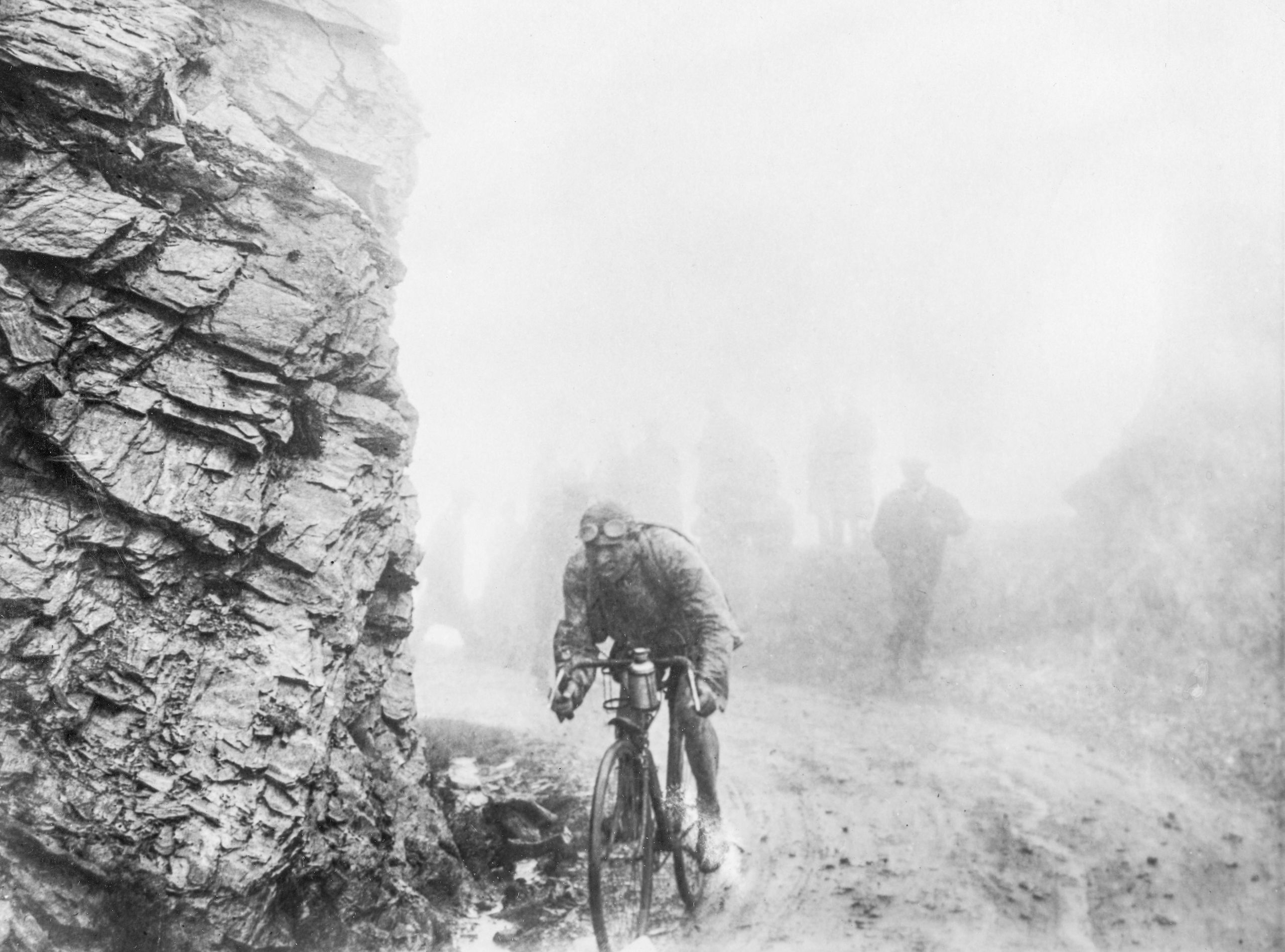
Think this year's Tour de France is hard? Don't expect any sympathy from the ghosts of 1926
As today's stage 16 rolls out of Evian, we look back exactly a century to when the town hosted the historic 1926 Grand Départ – kicking off a 5,745km ordeal that remains the longest and most brutal edition in the race's history
Pub pundits and sports scientists agree that the Tour de France is the ultimate test of human endurance, but compared with the pioneers of a century ago, today's riders have it easy. In 1926, La Grande Boucle was more than a nickname; that year's Tour took the peloton on a 5,745km ordeal around the perimeter of France. One hundred years on, that edition remains the longest, most brutal route in the race's history - a battle of attrition as much as it was a bike race.
The average length of the 17 stages was 338km. Yes, the average. One, stage 12, from Perpignan to Toulon, was 427km. But it's stage 10 from Bayonne to Luchon, through the Pyrenees, that's gone down in cycling folklore. Contested in apocalyptic, literally life-threatening weather conditions, this race-defining leg was won by the Belgian Lucien Buysse - in a time of 17 hours, 12 minutes. He went on to take the overall victory, and frankly, he'd earned it.
The 1926 Tour transcended sport. It took place in the long shadow of the First World War, a conflict many of the competitors had fought in - four editions of the race were missed between 1915 and 1918. Amid a feverish atmosphere of instability in central Europe, the 1926 event was riven with political tensions and dominated by strong personalities. At one political pole was the staunchly nationalist Tour director Henri Desgrange; at the other were members of the French Communist Party, with its newspaper, L'Humanité, campaigning for better conditions and pay for independent riders.
It was also a catalyst for change and became a key event in the evolution of the modern Tour, a point of inflection when the conflicting desires of everyone involved - riders, route-setters, teams, bicycle manufacturers and spectators - collided spectacularly. Arguably, 1926 was the year the Tour de France came of age.

The 1926 race covered the entire perimeter of the country – the longest edition ever
In 1926, for the first time since the Tour de France began in 1903, the race started outside Paris, in Evian, the Alpine town near the Franco-Swiss border. The route headed north, skirting the frontiers of Germany, Luxembourg and Belgium, then hugged the coast of Normandy and Brittany, tracing the seaboard to the Spanish border before swerving south, crossing the Pyrenees, wending east along the Côte d'Azur and heading north along the land border with Italy and Switzerland. Having cycled an anticlockwise loop of the country, competitors then had to pass back through Evian and re-ascend mountain passes they'd previously climbed before riding through Burgundy and central France to the finish line in Paris. It was, quite literally, epic.
From a modern perspective, the route looks nuts. And it was. But for Desgrange, the founding father of the Tour, who was still the route-setter and organiser in 1926, the event had never been simply about bike racing. Nor was it merely a vehicle for selling copies of his newspaper, L'Auto. He had a bigger vision, and for the Tour's 20th iteration, he pushed that to its limits.
A child during the 1870-71 Franco-Prussian War, Desgrange was part of a generation that lived in fear of German invasion. Concerned that his fellow countrymen were more interested in smoking and drinking than sport, leaving them weak and defenceless against the newly formed superpower on France's eastern flank, he became obsessed with health and national pride.
After becoming a successful - and world-record-setting - cyclist, Desgrange published a book, La Tête et les Jambes (The Head and the Legs), a training manual for Frenchmen to get fighting fit through bike riding and running. The routes he designed embodied his vision for France. "For Desgrange, the Tour was a way to promote 'France' as an idea and to build belief in nationhood," says Gareth Cartman, author of We Rode All Night, a historical novel about the 1926 race, "and that's why they went right around the outside of the country. It's a way of reinforcing the French border."
Cartman says the same rationale had led Desgrange to route the 1919 race through Alsace-Lorraine, a region previously absorbed by Germany, which had just been returned to France by the Treaty of Versailles. "He uses the race to say 'this is our country', but also to inspire Frenchmen to take up cycling and become stronger," Cartman explains, "and that's why he keeps making the Tours tougher. Every time riders conquer the test, he makes it harder... until we get to 1926."

Lucien Buysse proved to be the sport's ultimate hard-man
As a Cycling Weekly (then known as Cycling) reporter covering the 1926 race wrote: "With leisure and the right machine many could manage the mileage comfortably. But this is a struggle with time, when the rider who wins must keep to his machine although the roads are not worthy of the name, although he is lashed with rain and bespattered by mud and his limbs tremble with fatigue." These words would prove to be prophetic.
At 2am on Sunday, 20 June 1926, the peloton set off from Evian on a 373km 'plain stage' to Mülhausen. It was won by the Belgian Jules Buysse - no, not the eventual winner, but his younger brother. Jules, the youngest of three Buysse brothers competing in the race, also won the second stage, a 334km leg to Metz, but even early on, competitors were falling fast.
"Of the 126 riders who started the Tour, 15 fell out on the first day and seven on the second," reported Cycling on 2 July. Desgrange, who always intended the Tour to be a test of individual skill, strength and endurance, discouraged teams, and 82 of the riders who started the race were 'touriste-routiers', competing individually and without sponsorship. The remaining riders began working together, as a survival strategy. "On many stages, especially in Brittany and Normandy, riders effectively agreed not to race," says Cartman. "The route was so hard and long, they knew that, just to get to the Pyrenees in one piece, they should basically ride together. If people wanted to ride off the front, then fine. There was a kind of tacit agreement to not attack too hard."
However, each time they arrived en masse into finish towns, Desgrange responded furiously. "I think the best one was in Brest," chuckles Cartman. "After a 405km stage, he met them with folded arms and said, words to the effect of, 'You bloody bastards! You are now going to do sprints of the velodrome for this crowd because they've all come here to watch you and you can't be bothered to race each other.'" Cartman sympathises with the riders. "They knew they had three consecutive days coming up [amounting to] 900km, from Brittany to the Pyrenees, with no rest and in the middle of a heatwave. So of course they weren't going to ride hard. That's why Van Slembrouck kept the yellow jersey so long. And then came the big stage to Luchon, when the weather turned and the race started falling apart."
Once the race entered the Pyrenees, everything changed. Stage 10 started pre-dawn, in dreadful conditions, and the weather got progressively worse. Tourists in their cars stirred up the mud and made it even harder for the riders to get through. Marcel Bidot - future coach of the French team - broke a crank and tried to continue, pedalling one-footed. The judges ultimately allowed him to borrow a bike from a spectator - it was far too small, but he managed to get to Luchon. Of the 76 riders who started the stage, 22 were forced to abort, including the favourite and defending champion Ottavio Bottecchia.
As the elements turned vicious, the tough, working-class Italian Bottecchia - a bricklayer who'd served in a cycling battalion on the frontline of WWI, and had won the two previous Tours - retired from the race "weeping like a child", according to a later report in L'Équipe. Meanwhile Lucien Buysse, a man who had very recently lost his young daughter and was already riding through waves of grief, pedalled grimly onwards, through the storm-strafed peaks, mounting an attack on the Col d'Aspin that earned him an unassailable lead and control of the race.
"After his ride from Bayonne to Luchon, Lucien Buysse seemed the least exhausted of the survivors," reads the report in the 23 July, 1926 edition of Cycling. "On this stage he rode one of the most brilliant races in the history of the Tour de France. Some motorcars that should have followed him broke down on the crazy roads. The cold on the hilltops so gripped the hands of one or two riders they were unable to change a tyre after a puncture."
The middle Buysse brother was an Automoto team-mate of Bottecchia, and he'd helped the Italian secure victory in 1925, acting as the first domestique in Tour history. With a 30-minute lead in the general classification after stage 10, Buysse consolidated his lead with a consecutive win on the 323km mountain stage to Perpignan. He remained in the maillot jaune for the rest of the race.
Unsurprisingly, given his performance in the Pyrenees, Buysse was also named by L'Auto as meilleur grimpeur (best climber), an unofficial equivalent to the present-day King of the Mountains title. "It was an extraordinary Tour," concludes Cartman. "It was a pivotal point, which shaped the future of the race. Desgrange wanted to rip everything up and change it for the next year. He hated the flat stages, so he made them all time trials. He wanted it to be an individual competition, rather than teams and manufacturers using strategies to win."
Somewhat ironically, not a single stage in 1926 - Desgrange's toughest test and biggest national statement - was won by a French rider. That had never happened before and has occurred only once since, in 1999. This July, as French fans excitedly welcome to the race the nation's brightest prospect in decades, Paul Seixas, they will be desperately hoping the centenary of the 1926 edition doesn't come with a repeat performance.

The French organiser of the Tour de France Henri Desgrange (left) alongside Italian rider Amerigo Caccioni before the start of stage 8 of the 1932 Tour
5,745km: The total distance - the longest route in the race's history.
427km: The length of the longest single stage.
126/41: The ratio of starters to finishers.
17:12.04: The time it took Lucien Buysse to win the brutal 326km Stage 10.
238:44.25: Buysse's total winning time.
1:22.25: The time gap between the winner, Lucien Buysse, and second-placed Nicolas Frantz.
This feature was originally published in the 2 July 2026 print edition of Cycling Weekly magazine – available to buy on the newsstand every Thursday (UK only) while digital versions are available on Apple News and Readly. Subscriptions through Magazine's Direct.