Best road bike handlebars: how to choose them and best reviewed handlebars
The best bike handlebars are an often overlooked upgrade - Our experts explain why they're so important, the best from their testing, and outline what to look for when purchasing a new pair
The latest race content, interviews, features, reviews and expert buying guides, direct to your inbox!
You are now subscribed
Your newsletter sign-up was successful
It can be easy to overlook the importance of handlebars compared to other touchpoints and components that offer big performance gains, like wheels. As cyclists, we obsess over finding the right saddle and pedals, but often keep the stock bars.
But just like the best bike saddles, choosing the right bars will provide you with greater comfort and performance, making them one of the best road bike upgrades you can make. The choice can be overwhelming; bars designed for long endurance rides differ considerably from those for racing, where aerodynamics play a greater role. There are also material choices to consider, as well as the width. This has become increasingly complicated with the introduction of the UCI's new handlebar minimum-width restrictions.

An exceptional all-road bar, combining bags of comfort and control in a lightweight package.

If you need a high-performing road bar with a shallow drop that's also budget-friendly, these won't disappoint.

A wonder thing to admire, incredibly comfortable, superbly light, but like so many carbon bars, pricey! The FSA K-Wing AGX is very much one of the best, though.

Designed to enhance your aerodynamic position, they match a narrow hood width with some flare at the drops.

Our expert review:
While many gravel bars offer a significant amount of flare in the drops for better control on off-road terrain, there are a few options that are well-suited to road riding, too - and Zipp's SL-70 XPLR bars are possibly the best example.
The 11-degree outsweep and five degrees of flare at the drops add control and comfort without producing an extreme position at the hood, as some flared bars do. Combined with the short and shallow reach and the ergo tops, you have what we found to be a perfect all-road bar, ideally matched to long rides over less-than-perfect tarmac.
Read Luke's full review of the Zipp Service Course SL-70 XPLR handlebar

Our expert review:
As with Specialized's carbon shallow drop, the alloy version is offered in a 36cm width size and features the same design that's ideal for riders with smaller hands, thanks to the shallow drop of 123mm, and the short reach of 75mm.
However, unlike the carbon option, these are keenly priced, making them an inexpensive upgrade or a good option for a race bike, where a crash can prove costly in more ways than one if you're riding carbon fibre bars. Being made from butted aluminium they're strong but still impressively light - when we reviewed the bars out 36cm size tipped the scales at just 263g.
Read Michelle's full Specialized Expert Alloy Shallow Bend handlebars review

Our expert review:
The FSA K-Wing AGX may well be the most sculpted handlebar I’ve encountered. With a 115mm drop, 76mm reach and 12° flare, the numbers don't tell the whole story. The K-Wing also offers a subtle rise of 5mm and 10° forward curve, which is quite the feet, having so many different curvatures.
As a self-confessed weight weenie, the first port of call is always the scales - at 228g for my test 44cm bars, they are very light considering everything that is going on with them. I chose not to run the cables internally as my stem isn’t compatible, but when combined with FSA’s Aerodynamic Integrated Cable Routing (ACR) system, cables can be run fully internally.
The forward sweep added a little bit of reach to my position, although once you factor in the slight rise and narrower width, the difference in overall position was minimal. My first impression wasn't great, with the ovalised tops being quite large, when combined with the tape and some winter gloves, I was surprised how tough it was to keep hold of. I also really loved the flattened sections on the corners, while I don’t suffer from ulnar issues, it is an incredibly comfortable position, espcially when gloveless on warmer days.
I’d be lying if I tried to claim that I could detect any form of extra vibration damping; however, there was no untoward flex when out of the saddle, either and honking on them uphill. Really, all that lets down this incredible bar is the price, and understandably. The complex construction, attention to detail and low weight can't come cheap.
Read Tim's full FSA K-Wing AGX handlebar review

Our expert review:
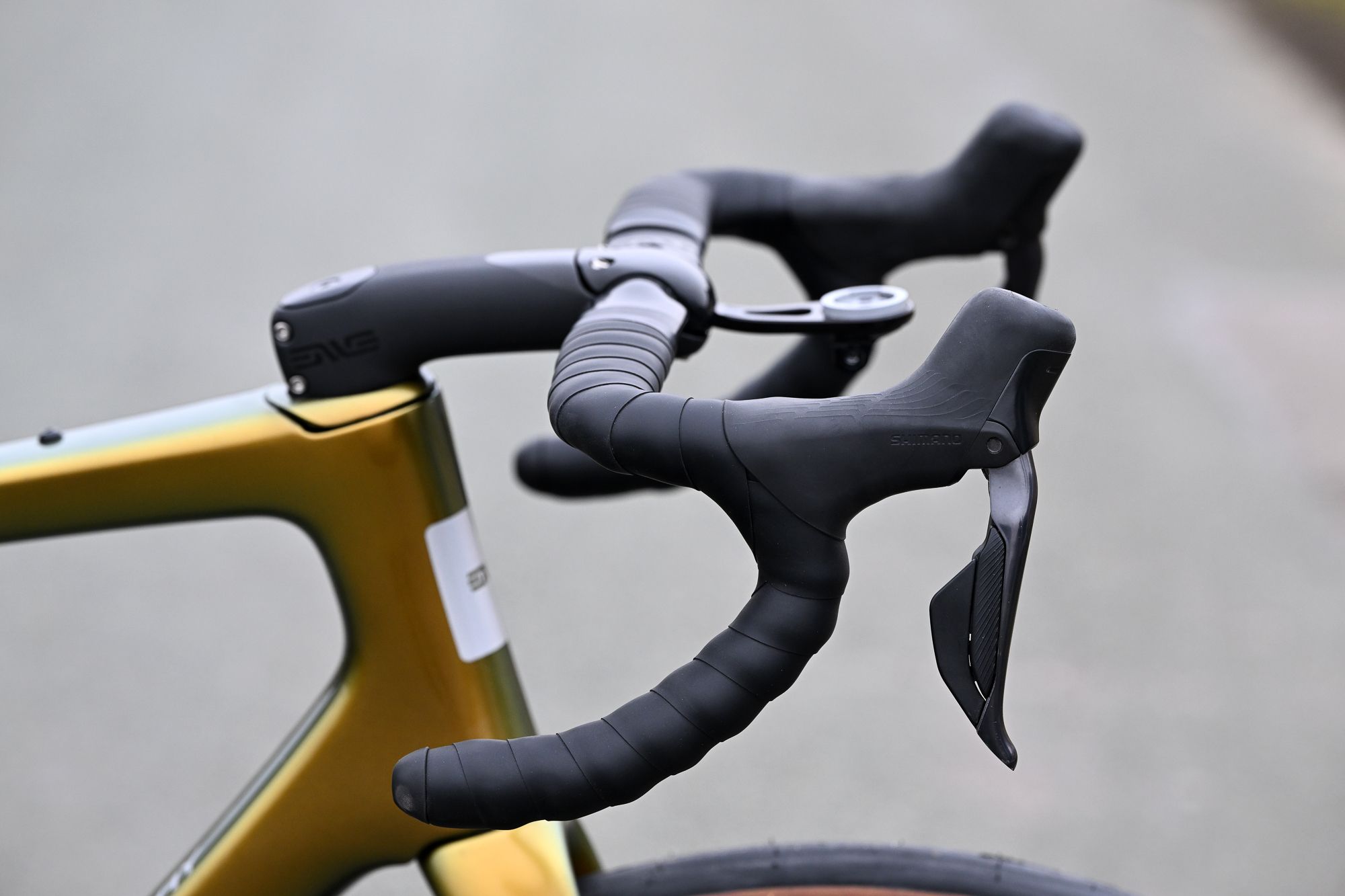
Enve needs little introduction from me; their naming convention might. SES standards for Smart ENVE Systems, and determines if a product is one that has been aerodynamically enhanced by aerodynamicist Simon Smart. The AR means this bar is the 'all-road' version, which means it is claimed to offer a little more compliance in the carbon layup for comfort. Final 'in-route', refers to where the cabling can be routed, which in this case, when paired with the ENVE’s In-Route Aero Stem through the bar and stem before entering the frame at the headset. The test bars were size 40cm (45cm at the drops), with a 76mm reach and 127cm drop, which comes in at 254g/8.8oz.
Out on the road, the flattener top was a pleasant place to be - comfortable with just enough compliance to take the edge off. The acute angled bend to the hoods allowed the full width of the tops to be used and is a nice touch.
I didn't get along with the flare myself, for the type of riding and the bike I had the SES AR's fitted to, a wide flare like that offered, I just didn't find myself using. However, that is the way more and more road bars are going, to allow for a more aerodynamic position at the hood while offering better control on the descents. It is also worth noting that because the shape bar, if you want a computer, you will have to use Enve's own stem mount or similar.
While they are fantastic on the road, there is a big tax for the brand name on the bar; the SES AR is one of the most expensive separate bar and stem combos out there, and that affects the score heavily for not offering great value.
Read Tim's full Enve SES AR In-Route Handlebar review
When reviewing handlebars the Cycling Weekly testers make sure to use them for as long a period as possible as well as undertaking rides of differing lengths. By doing so they can provide an indepth and insightful review that takes into account the pros and the cons of the product. When testing handlebars we take into consideration the price as well as how they perform and how easy they are to set-up and adjust.
Find out more about How We Test and our star rating system in our informative guide.
A writer and photographer, Tim has been covering cycling for over 20 years and riding bikes even longer. He racks up the majority of his on home roads in England’s Peak District but loves nothing more than venturing further afield, with the big mountains of Europe a particular favourite.
Luke has worked as a writer, editor, and copywriter for over 25 years, covering many sports, including Golf and the MLB. His first love, though, is cycling, and while he rarely steps out into the light to test products, spending much of his time sub-editing for our magazine and web articles, as an ex-highly skilled mechanic, you know you can trust what Luke has to say.
The sheer number of road bar options can make choosing the right pair for you a little tricky. To help you we’ve listed a number of the key considerations you’ll want to factor in before you buy.
Shape
Finding the right shape of bars makes all the difference when it comes to comfort. You’ll want to consider your riding style here. If you race and train hard then you’ll probably be concerned with aerodynamics. Bars with a deeper drop and longer reach will help get you lower on the bike which should translate to a more aero position. However, if you’re an endurance rider then you might benefit from a shallow drop and shorter reach, perhaps with some flare at the drops, too. Other considerations include the style of the tops - a flatter, aero profile can be more comfortable for some than the traditional round profile.
Width
The best road bike handlebars typically come in a range of widths, normally in 2 cm increments. You’ll want to consider your build when selecting the right width but perhaps more importantly, as above, your riding preferences. Racing cyclists tend to lean towards narrow bars, 38 or 36cm, that promote tucked in elbows to improve aerodynamics. Leisure riders may prefer a wider bar, say 42 or 44cm, which can help to open the chest up and improve comfort over longer distances.
Material
We’ve highlighted both carbon and aluminium bars in this guide. The former are more expensive but are typically lighter. However, the best alloy bars are also lightweight and the difference can be just a few grams. If you race at weekend you might opt for an alloy bar that’s cheaper to replace after a crash. Carbon bars also promise some added vibration dampening but this isn’t always easy to notice, or at least attribute solely to the bars. If you’re after a more comfortable ride then tyre choice and the pressure you run them at will likely deliver better results for less cost.
One or two-piece?
One-piece cockpits have become popular over the last few years but they are generally more expensive and more difficult to adjust and maintain. Traditional bars that are fitted to a stem remain the best option for those on a budget as well as those who like to maintain their own bikes at home.
The bars that come specced on a new bike are an estimate based upon the average shoulder width of the average person riding a bike in your size.
As most cyclists will protest, none of us are truly average, so tailoring the bars to suit you is a good idea. This is particularly relevant for women who have bought a unisex bike over a female specific bike: most women have narrower shoulders compared to men of the same height so will want a narrower handlebar.
Bars that are too wide can put pressure on your neck and arms, and will make riding the bike feel a bit like driving a truck. To the contrary, narrow bars will make you feel cramped, but it's worth remembering that narrower bars will bring your elbows in, having quite a significant impact upon aerodynamics.
The rule of thumb when selecting the correct handlebar width is to measure the distance between the two bony bits on your shoulders - in more scientific terms the distance between your two acromioclavicular (AC) joints.
This measurement gives you a baseline - if it's 38cm, look for 38cm bars - and so on. However, personal preference and riding style play a role, too. If, for example, aerodynamics are important to you, perhaps opt one size down.
Some riders like the stability afforded by slightly wider bars - so you could opt to go one size up - to a 40cm bar. However, this will mean that you are having to move your arms out to reach the levers, causing your shoulder blades to collapse which can cause discomfort.
The standard approach is to measure from the centre of the drops, but some brands measure from the outside, meaning their 40cm bar could be a 38cm in the former approach. It's best to check what approach the manufacturer you have in mind takes.
When it comes to handlebar width, though you can go up or down a bit depending on preference, there is a right and a wrong answer: too narrow or too wide will cause you pain and have bike fitters all over the world wincing. However, in the case of handlebar shape, it's much more down to personal preference.
Traditionally, road bars had a gentle round curve, which created a deep drop, putting the rider in a low position when off the hoods.
In recent years, compact handlebars have become more popular: these feature a straighter shape, which means the lower section of the drop is higher up. In the middle, are ergonomic bars: rounder than traditional bars, but they have a flat section in the centre which is ideal for hand positioning.
Choosing the best handlebar shape for you comes down to your riding style. If you're after fairly relaxed endurance rides, think compact.
If you want eyeballs out, nose to the bar time trial efforts and tend to hold the bars close to the bottom of the drops, think traditional.
Sitting in the middle, if you want a fair drop and tend to hold the bar right at its centre point, look for ergo bars where doing so won't put pressure on your wrists.
Different manufacturers will shape their bars their own way, and you'll also find adventure road bikes, gravel bikes and cyclocross bikes will sweep them out at the end to create a wider and more stable platform when riding in the drops.
One of the biggest conundrums facing cyclists upgrading their handlebars is the question of what material to choose.
Carbon handlebars drop the weight of the bike and they're often 20 to 40 per cent lighter than their alloy brethren. The material can also be moulded to any shape, permitting it to be perfectly designed to suit the ideal ergonomic fit. Plus, the carbon layup can be fine turned to create the best mix between strength, low weight and compliance. All sounds perfect?
The problem with carbon handlebars is that they're much more expensive, and a bit more fragile. Though carbon can be very strong, if it's damaged, it's not always as readily apparent as it would be on an aluminium bar and could go undetected.
Not only that, carbon needs to be treated with more care in the workshop - or home workshop - and even if you're using one of the best torque wrenches for bikes it's easier to crack if the wrong settings are used. A further con is the simple fact that aluminium bars are a lot cheaper.
Aero road bikes are becoming increasing popular, and the handlebar set-up plays a huge role in decreasing drag.
Handlebars that improve aerodynamics will often present a smaller surface area at the front, flattening out to create a longer surface area on the top.
This means they slice through the air more efficiently, and also has the added bonus of being comfortable to hold on a long climb. Plus, aero handlebars will be designed to cater for internal cable routing.
More premium versions will champion a high level of integration. The bar and stem may be one unit, and mounts for items such as cycling computers could be built in.
The bonus here is the watt saving. The downside is that if you decide you want to make a change to your fit with a shorter or longer stem, you'll need to fork out for an entirely new unit.
An actually quite important yet seemingly boring housekeeping point. Standard diameter handlebars used to always measure 25.4mm - this refers to the centre point where the stem will attach.
However, some brands are choosing to beef them up to 31.8mm for improved stiffness. This is fine, but you'll need a stem with a matching clamp size: no one wants to arrive home with their new purchase to find they've not got a stem to fit.