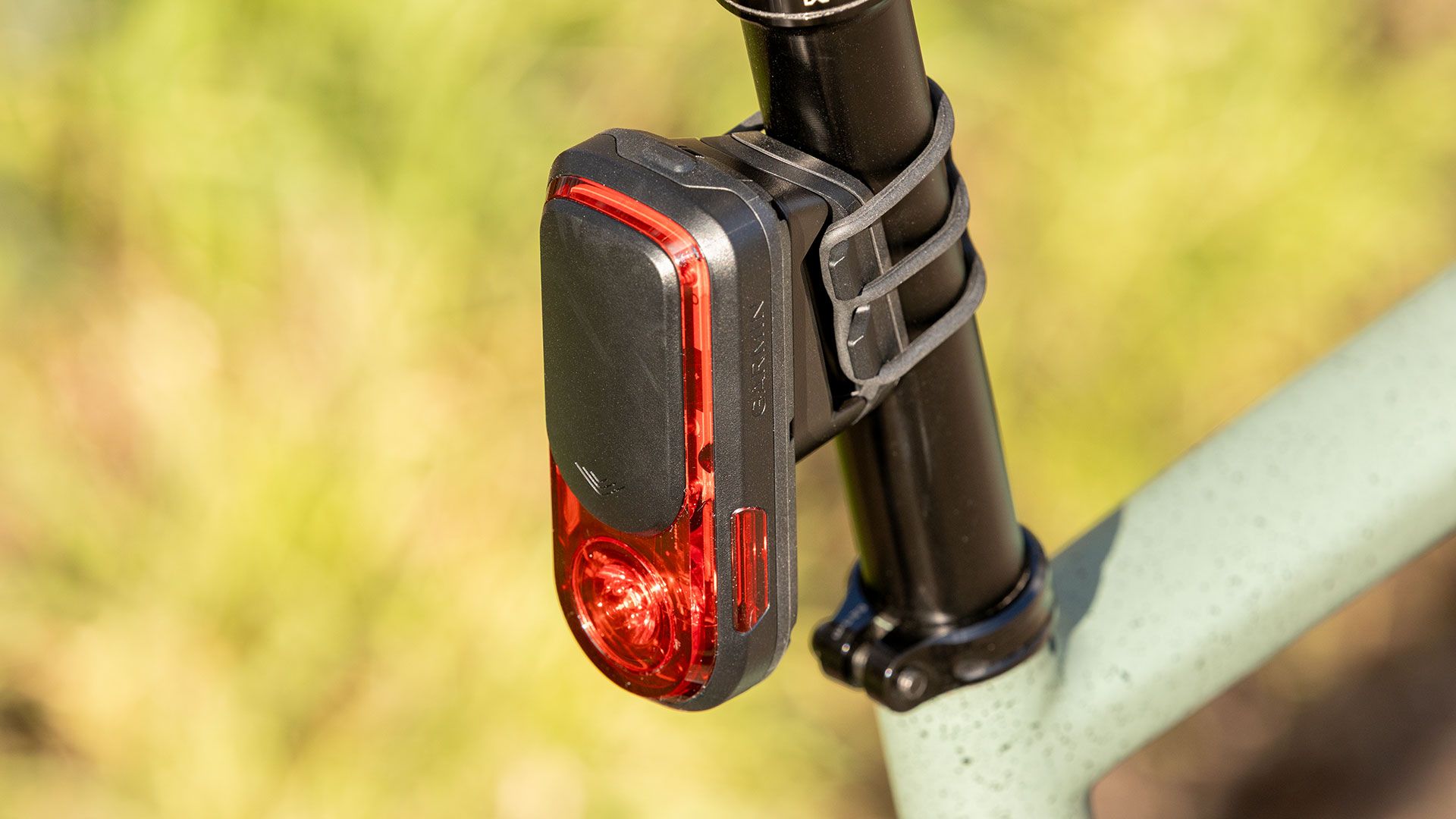
I tested 6 of the latest and best radar bike lights in 2026 to see if any can topple the market leader: Garmin
As a long-time Varia user, I’m no stranger to rearview radars - but can the likes of Wahoo, Lezyne, and Magicshine finally beat the category creator at its own game?
We ask a lot of the best radar bike lights: to accurately warn of approaching traffic, to provide audio and visual prompts, and even to include cameras to capture any erroneous activity. That is all before we even consider how they perform as a bike light.
Unfortunately, due to this complexity, some just aren't up to the job, turning a genuinely useful safety device into an expensive and dangerous gimmick. In my testing of the best rearview radars, I am looking for products that don’t report false positives – warnings of vehicles when there are none – or false negatives – a failure to warn of approaching vehicles. I’ll also assess detection range, detection angle, and accuracy at lower speeds, as well as how they interact with the best bike computers and against the enormous range of best bike lights.
To test the effectiveness of the best rearview radars, I rode a predefined 13km circuit that included a variety of traffic conditions and reflections from buildings and structures that could confuse a bike radar. I also set up a static rig on a long, straight stretch of road, which enabled me to accurately test range and confidently log false positives and negatives.
The winner of this test might not come as a suprise. While it was close, the founding brand of this category recently stepped it up with a new model, and that new model is, without a doubt, the new market leader. The Garmin Varia RearVue 820 might be expensive, but its accuracy is unmatched.

Our expert review:
The Garmin Varia RearVue 820 has quite the reputation to live up to – its predecessor, the Garmin Varia RTL515, was widely regarded as the gold standard and one of our own best bike lights. The change from Micro-USB has seemingly taken Garmin aeons to implement; however, this has allowed the brand not just to update the plug but to redevelop the product and take a step ahead of the competition.
The flagship Varia now delivers up to 100 lumens in day flash, and battery life is nothing short of phenomenal – I managed an impressive 11 hours 15 minutes in solid mode with radar. The seismic change is the switch from low-resolution 24 GHz radar to significantly more precise 60 GHz waves. In practice, this means it’s more responsive, more accurate, and better at tracking traffic at the same speed.
In the field, the difference is night and day; from an increased range – regularly surpassing 160 metres during my static test, even for smaller cars – to the RearVue 820’s ability to better pick out individual vehicles in a group. Same-speed vehicles are tracked with greater persistence, no longer dropping out at slow-moving roundabouts or at the approach to road junctions.
Less convincing is the classification of vehicles by size. Knowing whether you’re being followed by a bus, a car, or a motorbike is a seductive idea, but in practice, it's not yet reliable.
Nevertheless, the newfound clarity elevates the RearVue 820 to best-in-class status, something I’m willing to pay a premium for.

Our expert review:
Since switching to a Wahoo Trackr Radar last June for the majority of my riding, after four happy years with Garmin radar products, I haven’t been disappointed.
In a market awash with unimaginative blocks of plastic, the Trackr has clearly seen the sharp end of a designer’s pencil. Sleek and softly rounded, it’s easily the best-looking radar, as well as being functional. It’s easy to attach to either round or aero seat posts and holds with limpet-like tenacity. Setup is straightforward via Wahoo’s generic smartphone app, and head unit control is slick – I have used the Trackr Radar with both with serveral of the best bike computers, and the near-indistinguishable user experience has been positive.
Out on the road, radar functionality is flawless, with no history of false positives or negatives. With the only blip coming in my static tests, where small vehicles were not detected until around 75 to 95 metres. On the flipside, the Trackr is good at isolating vehicles within a group. Speed-matched vehicles would inevitably disappear but quickly reappear when traffic moves again.
One of the few units here with well-spaced twin LEDs, a useful feature that lets the top LED operate a different pattern from the lower. There are only four lighting modes – but they cover most bases. Output is relatively low at 53 Lumens, but that provides up to 800m of daylight visibility.
It's hard not to like the Trackr; it is one of the best units I have tested. Given how cheap it is compared to the Varia RearVue, you might overlook its slightly narrow field of view.

Our expert review:
The feature-rich Lezyne Radar Drive 300 is among the most versatile I tested. While many require a bike computer to display traffic threats, the Lezyne offers a couple of alternatives. Firstly, a free app or it can be purchased with a 1,200-lumen front LED light – Lezyne’s Radar React System displays traffic alerts on a rear-facing illuminated panel. Even when nothing is connected, the Lezyne will still warn passing traffic by utilising its light function to increase intensity. So, if you have no need for a bike computer, there’s no need to buy one. However, if you already own one, the Radar Drive 300 offers seamless integration with most leading brands.
Lezyne's detection algorithm is excellent, throwing no false positives or negatives during my tests, and the maximum detection range of 150m was routinely exceeded by larger vehicles. Its ability to detect Speed-matched vehicles was in line with those lights with a tighter 35° field of view.
The tail light outputs a whopping 300 lumens in Day Flash mode, which is exceedingly bright for a rear light. Its brutish aesthetic screams ‘see’ and be seen, but it’s slightly let down by a cumbersome mounting arrangement that forgoes any quick-release or quarter-turn mount solution in favour of a basic rubber strap design.
The Radar Drive 300 represents serious competition for Wahoo and Garmin.

Our expert review:
The IGPSport SR Mini breaks the mould, not just in size - being considerably more compact than others - but also in its hoop of 12 LEDs around its outer edge, over the conventional single-centred design used by Garmin and Wahoo.
The SR Mini performed brilliantly in my static range test, consistently picking out small cars at distances of 100 metres or more. This is about a 20-metre improvement over many other units in this test, giving me an extra second of warning. More often than not, it also managed to identify individual cars within tight groups, provided they weren’t completely blocked by a larger vehicle.
Riding out with the SR Mini on my test circuit, I noticed no false negatives, but at least two false positives. The first was a reflection off a stone wall from an oncoming vehicle, and the second was a ghost vehicle that briefly appeared about 50 meters behind me. While not critical, false positives are distracting enough that I'm economical with the SR Mini’s rating.
The iGPSports companion app is a bonus if you don’t own a bike computer, and the mounting interface is quarter-turn, but for some reason, iGPSports only supplies a saddle rail mount. Would it be too much trouble to include a simple seatpost mount?
As part of this test, I also tested two other lights: the Magene L508 and the Magicshine SeeMee R300. While they function perfectly well as lights, with both having feature-rich specifications that offer decent value, neither performed particularly well as radar units, regularly throwing false positives and negatives. Thats not to say that you shouldn't buy them at all, by any means; I'd certainly consider others above first, particularly the IGPSport if you're on a budget.
As part of this year's testing, I assessed well over a dozen radar and smart bike lights for use year-round.
Specifically, in my testing of the best radar bike lights, I broke down my data acquisition into two smaller tests. I wanted to provide both a scientific and real-world data log.
For the first test, I set up a static rig along a long, straight section of road. This, first and foremost, allowed me to understand how each light worked, but to accurately test the range and log false positives and negatives with confidence. This was simply measuring out a long 200m section of road and placing my bike in a stand with both a Wahoo and a Garmin Bike computer to hand.
I then verified this data in real-world scenarios by riding a predefined 13km circuit multiple times for each light, across a variety of traffic conditions and at different times of day.
Not to mention, I also tested all of these lights for their general function and features. This included battery capacity, recharge times, mounts, and compatibility with the best bike computers, in which I used both the Garmin Edge 1050 and the Wahoo Elemnt Roam 3.
I grew up just a stone’s throw from the foot of Box Hill, on the busy roads of Surrey, even back in those days. So, it's no surprise that I have always looked for ways to make myself safer on the roads.
After initially writing off radar lights as another rich boy gimmick, I was converted by my brother 6 years ago and have never needed to 'look back'. So, it seemed only fitting as a long-term user that I be the one to take on this groupset, putting this new wave of the best radar bike lights to the test.
While I no longer reside in Surrey, the dark, narrow lanes of the Cotswolds are equally filled with similar large SUVs and heavy EVs racing around at speed, all with somewhere to be. Making it a great place to test these complex bike lights.
Vehicle detection range (claimed)
Vehicle detection range (tested - small vehicles)
False positives detected
False negatives detected
Garmin Varia RearVue 820
175m/190yds
Over 150m/164yds
No
No
Wahoo Trackr Radar
150m/164yds
75m/82yds
No
No
Lezyne Radar Drive 300
150m/164yds
Over 100m/109yds
No
No
iGPSport SR Mini
160m/175yds
Over 100m/109yds
Yes
No
Magene L508
140m/153yds
80m/88yds
Yes
Yes
Magicshine SeeMee R300
140m/153yds
85m/92yds
Yes
Yes
It's worth noting that radar lights are an additional feature on what is already a complex product: rear bike lights. So, your first port of call when considering which one might be best for you should be to consider what you need from a rear light first, before delving too deeply into radars.
Here is a quick recap on how to choose a rear light, which should help narrow things down:
So, how do you choose a rearview radar light?
Previously, this was largely driven by compatibility with the best bike computers. If you were running a Garmin unit, you would likely look to the Varia and so on. With more brands coming to the market, there is now a much more urgent need for computer brands to open up either platforms to others. Worth noting that, in the same way, it is opening up the computer market as well, with brands like Magene and IGPSport keen not just to sell you their lights.
In a way, this is good news for consumers, as it places less emphasis on brand compatibility and more on the units' features, such as detection range and the radar's viewing angle. Ultimately, it puts the emphasis on where you ride.

If, like me, you live in a rural area with lots of twisty, tight lanes, you may well want to consider models with greater detection ranges and those that can do this at very wide angles, like the Garmin Varia RearVue 820, so you can nip into a pull-in or layby.
For those who hit the main roads into the city or town, while detection range will certainly be a consideration, you will likely want the unit to be better at picking out vehicle groups and their sizes, as well as the speed at which they are approaching. This is where units like the Wahoo Trackr Radar thrive.
The large majority of rearview radars use a similar technology to detect what is behind you, the speed at which it is travelling, and how many vehicles there are by utilising radio waves. Very simply, the unit sends out a signal and collects data on any of these signals that have 'bounced off' vehicles. It is then up to your computer, the app, and the software to process this data into visual or audible prompts.
A false negative is just a fancy way of saying the unit failed to spot a vehicle approaching you, which, in my opinion, is an obsolete failure when it comes to the best rearview radars. Even if it spots the vehicle late or loses it, this is forgivable depending on the road furniture and parcours; at the very least, it has made you aware of something there.
False positives or ghost readings, however you would like to call them, are just as frustrating and distracting but more forgivable than false negatives. The algorithms within the software have a lot to process when it comes to working out what is a reflection, a vehicle, road furniture, etc. Luckily, none of the units I tested suffered too badly with this issue; however, at least when it isn't sure, the unit will show it as something being there. This shows the units are only as good as the software that supports them, but at least brands can update with firmware.
Something that luckily I haven't seen any of is a false positive being prioritised over a genuinely positive match with a moving vehicle.