'When you heat train, you produce more blood': why sweaty sessions indoors can be as effective as altitude training
As temperatures soar across Europe, we find out how riders prime themselves for the heat by deliberately raising their core temperature indoors
This year's Tour de France was the hottest on record, with temperatures close to 40ºC for many hours of several stages. At the roadside, fans placed newspapers on their heads as ad hoc shelter, while cold drink were more elusive, and more craved, than a Tadej Pogačar autograph. Even so, the 184 riders who started the race in temperatures of 34°C in Barcelona seemed largely unaffected. And that’s not just thanks to the ice socks and slush puppies that they were fed on a daily basis – it was thanks to their preparation.
Heat training has become an indispensable part of a rider’s schedule, particularly in the last five years. Now, alongside 25-hour training weeks and leg-sapping efforts to get into Tour de France shape, riders complete hour-long indoor training sessions dressed in winter gear, with the aim of getting as hot and bothered as possible. Meanwhile, trips to the gym now include an obligatory 30-minute stay in the sauna.
These sessions are designed to help riders adapt to racing in the heat, particularly sweltering Grand Tours – yet not just to survive but to actually perform better. Studies over the past 15 years have consistently shown that both active and passive heat training have a positive effect on a rider’s performance.
“When you do heat training, you increase blood plasma volume – essentially, you dilute the blood,” explains Tim Podlogar, a lecturer in exercise physiology at the University of Exeter and a staff member of the Tudor Pro Cycling team. “This reduces the haematocrit – the percentage of blood volume made up of red blood cells – which serves as a trigger for the body to produce more of them. Research has shown that over a few weeks it can increase red blood cells in the same way as EPO or spending time at altitude.”
Crucially, these physiological effects are not reserved exclusively for WorldTour professionals. Amateur riders looking to conquer a summer sportive or improve their local time trial times can reap the exact same blood-boosting benefits from a few targeted, sweaty turbo sessions. If that feels like a step too far, then pity the pros. Training indoors in a boiler suit without a fan might seem like a grim prospect, but it’s a sacrifice that riders have to make nowadays if they want to be competitive in the world’s biggest race.
“Like with any training, you’re getting better no matter what, but if you don’t do heat training then you do definitely notice it,” says Australian climber Chris Harper, who is riding at the Tour for Pinarello Q36.5. “If you haven’t spent the time doing it then when you get into a race you feel underprepared. The benefits are the same as going to altitude but you can do it from home.”

Pros like Red Bull-Bora-Hansgrohe's Aleksander Vlasov – seen here dousing himself with water at the 2025 Tour de France – appreciate the value of heat training
Climate change might be giving us more extreme temperatures – and the hot weather affecting Europe this summer has already broken several records – but training and racing in hot weather isn’t new. France in July is hot – and that’s when the race has been held since its first edition in 1903. What is relatively new is the Tour’s participants realising that they stand to gain from specifically training in the heat. Maybe they’ve been a little slow on the uptake, as Podlogar explains that the science isn’t novel: “The history of heat acclimatisation improving exercising performance in the heat dates back to the early 19th century, when people were sent to work in hot climates. After a few days of exposure to hot environments they became better accustomed to work in the heat.” This was especially true in the American Civil War of the 1860s, where heat casualties were mostly limited to new recruits, with veterans faring much better under the summer strain.
Yet for cyclists, training for warmer climes didn’t become popular until the mid-2010s, and it took a few more years for it to become ubiquitous. “A study in 2010 showed that heat acclimatisation improved exercise performance in both cool and hot conditions, and teams began using it,” Podlogar says. That study, by Santiago Lorenzo of the University of Oregon, USA, showed a performance improvement of 5% in cooler environments after just 10 days of heat acclimatisation.
Ahead of the Tour de France, and before other races in warmer climes, coaches now incorporate heat training into a rider’s schedule at least twice a week. “Scientific evidence is clear that to include heat acclimatisation, an athlete needs a minimum of five to nine sessions to get the benefits,” Podlogar says. “Men need at least five days of exposure, and women nine days.” Heat training also forms part of a rider’s schedule in the latter part of an altitude camp.
“I normally do it in December before going to the Tour Down Under, as you have the double benefit of coming from a cold European winter into a warmer climate, and I find that it’s a really great tool to get in shape in the winter,” says Jayco-AlUla’s Swiss rider Mauro Schmid. “I also try to do it a little bit in the summer as I can really achieve some great results with heat training.”
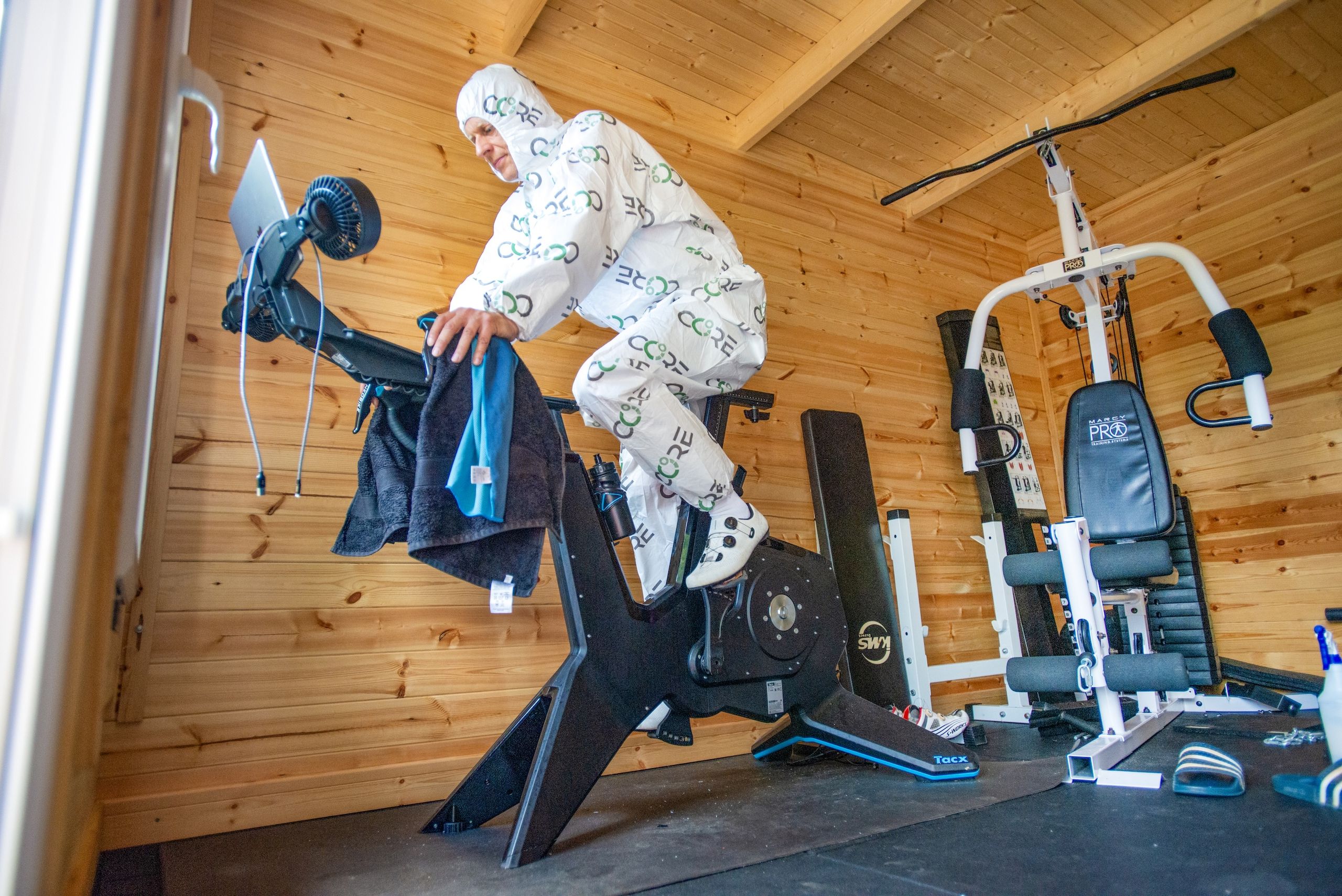
The methods of heat training are not complicated. The most common involves dressing up in winter gear or a one-piece impermeable suit such as painters overalls and pedalling on the turbo or rollers for around an hour at Zone 2. The key is not to stress the body further with high-intensity effort. The principal aim is to gradually raise the core body temperature to between 38.5°C and 39.5°C. Any hotter and the effects are counterproductive.
“You don’t just want to make the surroundings hot, but also humid, so that you can’t easily lose the heat,” says Puck Alkemade, the lead physiology researcher of Core, whose real-time core body temperature sensor is used by the majority of Tour de France teams. “If you’re exercising in a full-body suit, you are creating a micro-climate around you, from which the heat and sweat you produce cannot escape. This warms you up quicker, makes your body work even harder to keep sweating, and this causes the adaptation.”
Schmid admits that “it can be quite hard mentally on the rollers when it’s nice outside” but he trains regularly indoors all in the name of heat adaptation. Over the years, the 26-year-old has learned the best methods. “I think a lot of people go a bit too hard – it shouldn’t be super uncomfortable and you need to be careful that your heart rate doesn’t go too high,” he says. “I’m a believer in not overdoing it and I’d rather do a few more sessions without really pushing myself to the absolute limit, rather than doing fewer sessions but destroying myself.”
If you don’t fancy getting exceptionally sweaty on the turbo, an alternative is the passive approach: sitting in a hot bath or a sauna for 30-40 minutes. Again, the goal is targeting an elevated core temperature, being careful not to exceed 40°C.
In the bath, you won’t notice it, but you’ll be sweating buckets. Up to two litres of sweat loss over an hour is not uncommon. “As you become heat-adapted, you start to sweat earlier and produce more sweat, meaning your core temperature doesn’t rise as quickly during exercise than it otherwise would,” Podlogar explains.
Most riders opt for a hybrid approach, getting hot on the turbo, then having a hot bath. But which works best? “The science is not completely sure on this yet,” Podlogar says. “What seems fundamental is that you need to have a high core body temperature coupled with a high skin temperature, which together increase the sweat rate and acclimatise you to the heat.” Is simply riding outside in warm weather not good enough? “No – because no matter how hot it is, there’s still so much airflow around you, cooling you down,” Podlogar says. “Indoors, you can really control the environment.”

Core claims that two-thirds of the Tour peloton are wearing their Core sensor, either through official team partnerships or private agreements. Before the sensor, the only other way to measure the body’s core temperature was via a rectal thermometer – and that’s not viable while riding a bike.
Core’s non-invasive sensor sits on a chest band that pairs with a heart rate sensor. It estimates the body’s real-time core temperature from a calculation that takes into account skin temperature and heart rate. The company claims “medical-grade accuracy”, whereas a comprehensive scientific review of the sensor in 2021 reported that, compared to a rectal thermometer, the Core sensor is “acceptably reliable” albeit often underestimating core temperature by up to 0.3°C. More recent studies have supported these findings.
The Core sensor remains the thermometer of choice for the pro peloton – and there’s one key reason. “Sometimes how you feel doesn’t match with how hot you actually are,” says Alkemade. “The Core sensor is objective, and it tells you whether you’re overheating or not. This gives you a better understanding of how to hydrate and fuel, which is especially important for pro riders.” In other words, the sensor helps them to optimise their adaptations from heat training.
“You cannot always trust technology to the maximum, but the Core sensor is a good tool and I use it to watch my core temperature and to figure out where my limit is,” Schmid says. “When my temperature gets really high I stop earlier. It’s especially useful in racing as if you see you have a super-high temperature you need to be careful about pulling and not overdoing it. With a high core temperature it’s not a good idea to attack with 40km to go, for example, so it’s a good reminder to save the legs a little bit because sometimes you cannot feel that you’re overheating.”
As Podlogar highlights, science’s understanding of how to maximise the benefits of heat training is incomplete. A decade from now, Tour riders will no doubt be using more advanced, precise methods. Heat training, though near-universally adopted, is still in its relative infancy. “In literature we say that we should aim for a core temperature of 38.5°C during heat training, but we don’t actually know if this is the optimal temperature for everyone,” Alkemade admits.
The future points towards a more individualised approach. “A rider might respond in a totally different way from one heat training session to another due to fatigue, a lack of sleep or for many other reasons,” Alkemade says. “It’s therefore hard to predict their response, and that’s where individual monitoring becomes more important.”
Podlogar, who co-authored that 2021 review into the Core sensor’s accuracy, is more interested in “really understanding what’s driving these adaptations – is it the skin or the core temperature? And how can we optimise the load of heat adaptation?” He’s also curious to find out which method, passive or active, is more beneficial, and how best to heat-train while at altitude. “There’s still lots we’re unsure of but it’s very clear that heat training does help,” he says. “What we do know is that you can’t win races in the summer without first doing some proper heat training.”
38.5-39.5°C The optimal core body temperature riders aim to reach while heat training.
5% The potential boost in cycling performance after just 10 days of heat acclimatisation.
5-9 The minimum number of heat exposure sessions required to trigger meaningful adaptations.
2L The amount of sweat a rider can lose during a single, hour-long heat training session.
>40ºC The danger zone that core temperature must not stray into.
Be warned, heat training places extreme stress on the body and carries a risk of heat exhaustion or heatstroke. Pro riders perform these sessions under expert supervision using real-time core temperature monitors. Attempting this at home without accurate temperature tracking or medical clearance can be dangerous. Approach heat training with caution: ensure you are pre-hydrated with electrolytes, and stop immediately if you feel dizzy, nauseous, or faint. Never attempt to push through the warning signs of overheating.
This feature was originally published in the 9 July 2026 print edition of Cycling Weekly magazine – available to buy on the newsstand every Thursday (UK only). Digital versions are available on Apple News and Readly. Subscriptions through Magazines Direct.