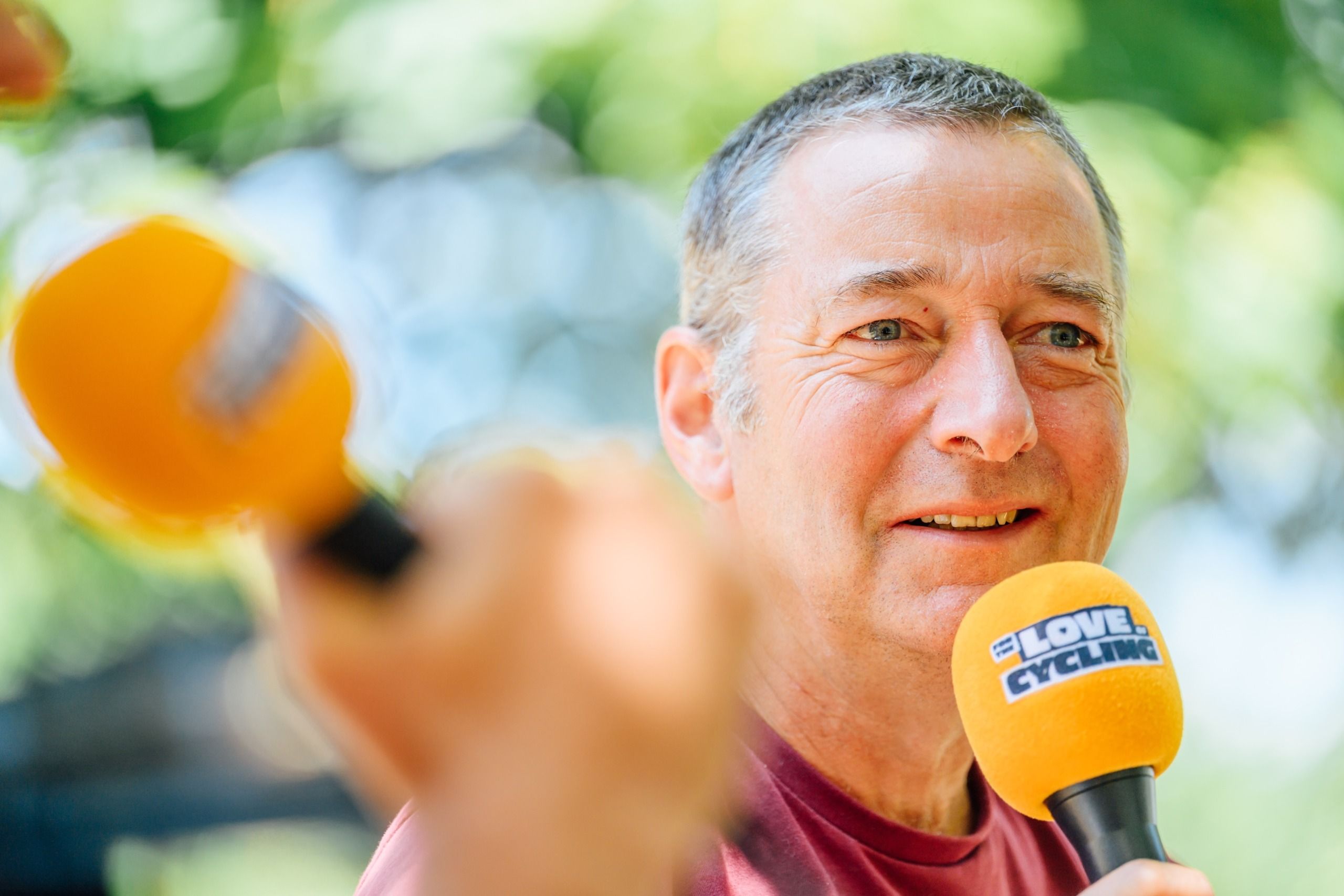
'The only rider I'd heard of was Lance Armstrong': Ned Boulting on learning the craft, confronting Big Tex, and that 'yellow jumper' gaffe
From acting in Germany to making the tea on Soccer Saturday, the ex-ITV commentator on his film-making family, rock star cousins and shunning Saudi Arabia
Reporter, presenter, commentator, podcaster, writer, editor, columnist, pundit, performer – Ned Boulting wears more hats than Hedda Hopper. Born in Bedford in 1969, Boulting studied languages at Cambridge and ended up working on Sky Sports’ Soccer Saturday after years trying to make it as an actor in Germany. After joining ITV in 2001 as a football reporter, Boulting’s big break came two years later when he was despatched to cover the 100th Tour de France.
Knowing very little about cycling – he famously called the maillot jaune ‘the yellow jumper’ – Boulting emerged unscathed from Lance Armstrong’s fifth reign in yellow. Boulting covered 22 more Tours for ITV – latterly alongside David Millar – before ITV lost the broadcasting rights. This July he returned to the Tour with his podcast 'For the Love of Cycling'. He is a passionate Londoner, darts aficionado and self-confessed “terrible tourist”.
What’s your earliest cycling memory?
When I was 11, my dad bought me a blue Raleigh Olympus. The bloke selling it plonked it in front of us and said: “That was in the Tour de France.” We didn’t know enough to doubt him at the time. Within seconds, my dad handed over £30.
Can you summarise your journey to sports journalism?
At university, I messed around doing theatre. I lived in Hamburg during my third year and moved back after graduating because I didn’t know what to do with my life. Occasionally I played German characters in small BBC dramas or British characters for German telly. Back in England, I got a job on Soccer Saturday one day a week. I made the tea and helped with the graphics when the team news came in. Jeff Stelling was my mentor.
How did the door to the Tour open for you in 2003?
I was one of ITV’s Champions League reporters when Channel 4 gave us the rights for the Tour de France for free. ITV inherited [anchor] Gary Imlach, but they wanted to put their own little stamp on it and send some staff out there. So they pointed at me and said: “Why don’t you do it?” My prior knowledge was absolute zero. Literally, the only rider I’d heard of was Lance Armstrong. I didn’t even know they raced in teams.
It must have been a baptism of fire?
Well, it was a scorching summer. I remember trying to fry an egg on the bonnet of our car at the finish, the day Armstrong cracked and Jan Ullrich won the time trial. It was 39°C. Of course, the egg didn’t fry, it just sat there limply getting warm. The worst bit of telly I’ve ever done.
Did Armstrong intimidate you?
Only because I wasn’t prepared for the maelstrom that followed his every move. I found Armstrong tremendously engaging, borderline charming at times. A fascinating character. I warmed to him straight away. But it didn’t take me long to encounter his other side.
Do you remember the first time you had to ask difficult questions?
Very clearly. It was 2004 when he chased down that [Filippo] Simeoni breakaway. It was classic Armstrong bullying. The American journos didn’t have the balls, but I pressed him on it. That was the first time I got the glare: his eyes narrowed and the blood drained from his face. Sports journalists get a lot of stick for anodyne questions. But there’s something quite visceral when you’re standing [in front of] someone, challenging them.
Did it take long to live down the ‘yellow jumper’ blunder?
I hadn’t realised I’d done it until the race was over. Some friends told me what I’d said but there’s no recording of it anywhere. I was so traumatised by how hard the job was that I was pretty sure I wasn’t going back. But here I am.

A picture of dominance: Lance Armstrong chases down Filippo Simeoni at the 2004 Tour de France
How did you find the shift from reporting to commentating?
David Millar and I were thrown in the deep end. Everyone had been so used to Phil [Liggett] and Paul [Sherwen] – the voices they listened to for their entire education in the sport. Without warning, they were presented with me and David – rookie commentators. Listening back to our work in 2016 is not a comfortable experience. It took us years to get up to speed.
But for many, you became the new voice of cycling.
Weirdly, the Pidcock generation. Tom often told me his introduction to the sport was 7pm and listening to me warble along with David. It took a decade to rid myself of impostor syndrome.
What’s the best bit of any Tour?
When you get the live helicopter shot from the start of the first day. Everything’s up for grabs. No one’s crashed. No one has scored any mountains points. The whole thing’s perfect… and then it just falls apart over the next 21 days.
Your last book delves into a long-lost piece of Pathé film from the 1923 Tour – have you ever been more obsessed?
No. The only thing that comes close is my obsession with civil aviation as a kid. I used to spectate at Luton airport, write down the numbers of planes. The Pathé film came through my letterbox during the second lockdown of the pandemic. This providential bolt of light arrived – appropriately enough, for cycling – rolled up in a jiffy bag. I knew straight away it would take over my life.
Your grandfather and great uncle – the Boulting Brothers – were prolific English filmmakers. Have you watched much of their back catalogue?
Bits. It’s of a certain era. A couple of their films are very widely acclaimed. They launched the career of Richard Attenborough, whose breakthrough role was Pinky in the iconic Brighton Rock. They owned Shepperton Studios in West London, where there’s a cafe called Boultings.
Have you inherited your grandfather’s outspokenness and strong political awareness?
I’ve only known my grandfather from reading about him. But he and his brother were Labour Party members and one was a councillor. He wasn’t a terrific human being, but he drove ambulances in the Spanish Civil War, and that took a great deal of bravery. I’m proud of that. The older I get, the more politically engaged I become. It’s incumbent upon us to act, now more so than ever.
Between them, the Boulting Brothers were married 11 times. Family gatherings must have been fun.
My dad doesn’t know how many brothers and sisters he’s got, let alone cousins. Jordan Stephens from Rizzle Kicks and Crispian Mills from Kula Shaker are cousins of mine. With a family that big, you’re going to have a couple of rock stars just by sheer weight of numbers.
Do your wife and children share your passion for cycling?
Absolutely not. Having said that, my youngest, who’s now 23, wanted to come to Paris-Roubaix last year. We took the train over and watched the women’s and men’s races. So, there’s something in the DNA – they ride bikes everywhere.
You’ve been vocal about sportswashing in the past. Has it become a delicate tightrope?
I guess so. I’ve been lucky enough to be able to make a few strategic decisions. For example, I’m never going to work in Saudi Arabia. I used to go regularly to the UAE Tour until one day I woke up feeling grubby and decided: “Never again.” I also had a column in Metro until they started doing clickbait journalism about cyclists shooting red lights, which I felt very uncomfortable sitting alongside, so I resigned.
Do you get recognised on the street?
Sometimes people mistake me for Chris Boardman, though less now because we haven’t been together on the telly for a while. Chris admitted recently that he’s been mistaken for me, which really infuriates him.
Beyond the world of sport, what makes you tick?
I adore travel, but I’ve become a terrible tourist because of cycling. The other thing I completely love is reading. I read Samuel Beckett’s novel Molloy recently and I was blown away by its brilliance – a bicycle is one of the main characters.
What makes you mad and sad?
The deleterious effect of social media is the saddest thing and impinges on all our lives. The last time I bought an ice cream, there was a kid and her mother both just scrolling through nonsense on their phones rather than enjoying the time together. We don’t even know how damaging this is, how it’s changing our behaviour.
On a positive note, give us some reasons to be cheerful.
The change in London – it’s a cycling city now. We’ve crossed the Rubicon. The critical mass has been obtained and it’s permanent. And one of the biggest drivers of that change has been the younger population, who have realised that it saves you a hell of a lot of money if you ride from A to B.

Boulting (R) recording his 'For the Love of Cycling' podcast with co-hosts David Millar (centre) and Peter Kennaugh (L)
Biggest cycling bugbear? Snobbery.
Best Grand Tour and best Monument? Tour de France and Paris-Roubaix.
Bunch sprint or mountain-top finish? Bunch sprint.
Will Pogačar break Cav’s stage record before he retires? Oof. No!
Dream Grand Départ location. Brest [in France], followed by Brittany or Paris.
Ideal Tour route? No mountain-top finishes, and as many Ben Healy-type days as possible.
Where should the Tour next finish outside Paris? It should never finish outside Paris. It was grotesque in Nice.
Which other country should host a Grand Tour? Germany.
Biggest cycling hero? Peak Julian Alaphilippe.
Favourite food? Salade Niçoise washed down with a glass of Sancerre.
Paul Seixas or Luke Littler? Ha! Seixas.
Cycling’s GOAT. Marianne Vos.
Favourite podcast? 'Football Clichés'.
Last pro you spoke to? Does Jaan Kirsipuu [Estonian former pro rider] count?
Your most famous friend? Mel Giedroyc is a good mate from Cambridge.
This article was first published in the 13 August 2026 print edition of Cycling Weekly magazine – available to buy on the newsstand every Thursday (UK only) while digital versions are available on Apple News and Readly. Subscriptions through Magazine's Direct.